Muse AI Scraping: Browser Access, Connectors and Export Limits

Muse AI scraping can mean opening a few pages, calling a data API or delivering a repeatable dataset. Those jobs need different evidence. This guide separates documented capabilities from provider demonstrations and gives you a practical acceptance plan before you depend on Muse for recurring web data.
- 1Meta documents Muse's browser and custom connectors. That supports evaluating web collection, but does not establish universal site access or batch reliability.
- 2A scraping provider's Muse tutorial uses that provider's API. Its results do not establish the performance of Muse's browser alone.
- 3Accept a collection job only after checking source coverage, required fields, missing values and the actual exported file.
- 4Keep login, access restrictions and approval requirements visible. A blocked source is a status to report, not a value to invent.
- 5This is a source-based capability guide and proposed evaluation plan. No Muse extraction run or performance benchmark was conducted for this article.
What Muse Can Actually Do With Web Pages
A browser inside an agent environment
Meta's September 8, 2026 safety architecture post describes a dedicated cloud computer with a browser, workspace and tools. It also describes custom connectors for services with APIs or CLIs. The Muse Connector Platform guidelines, checked October 29, explicitly describe browsing as an existing capability and ask connector builders to add value beyond it.
That establishes a useful starting point: Muse has mechanisms for working with web information. It does not answer whether your target table loads correctly, whether every page of a catalog is collected or whether tomorrow's output matches today's schema. Those are properties of a particular workflow.
The distinction matters because a plausible summary can hide an incomplete collection. A few examples may be enough to answer a narrow research question. A sales or operations process may require every expected record and a dependable delivery format. Judge each against its own requirement.
For an evidence-led research task rather than a dataset project, the Muse competitor research workflow provides a narrower starting point.
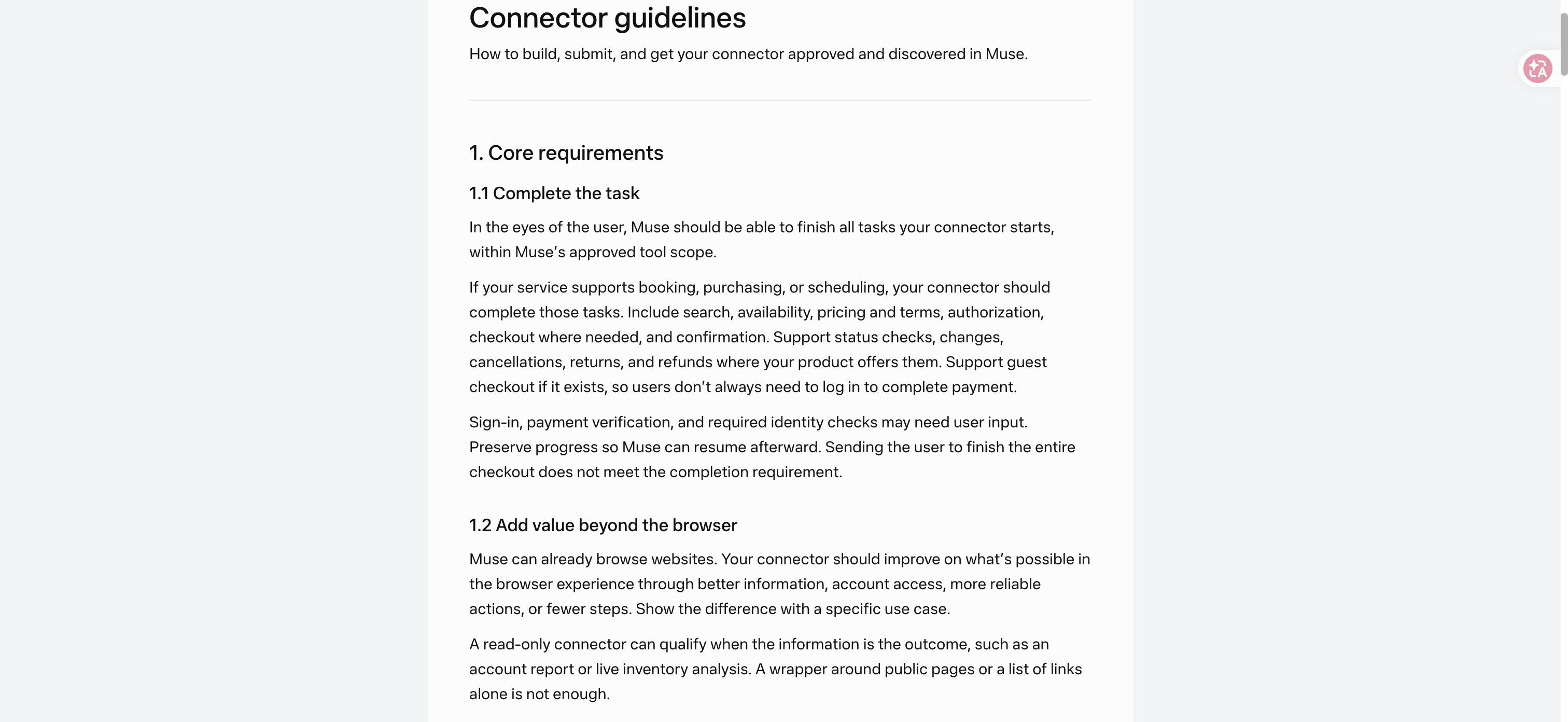
Official Muse Connector Platform screenshot, checked October 29, 2026. Documentation evidence, not an extraction result.
Choose the Collection Route Before Comparing Results
Browser, provider API and approved connector are different routes
The word scraping often collapses several systems into one. Keep them separate so you know which component needs access, credentials and testing.
Route | What supplies the information | Evidence to request | Main evaluation question |
Muse browser | Pages the agent can reach and read in its browser | Source URLs, observed fields and page coverage | Did it read the intended live pages completely? |
A provider API used by Muse | Responses from an external data service | Endpoint, request scope, provider response and resulting file | Is the provider response suitable and preserved accurately? |
A reviewed platform connector | Tools exposed within the connector's approved scope | Tool permissions, account scope and completion status | Does this connector return the required business object? |
A separate reusable collection Bot | A configured collection process outside Muse | Validated run output, schema and delivery record | Can the collection stage be repeated and checked? |
Pro Tip: Write the retrieval route into the dataset manifest. If the route changes between runs, treat the next comparison as a new collection method until you have checked compatibility.
What a provider's published example establishes
Oxylabs publishes a Muse integration tutorial built around its Web API. The example searches for products, retrieves pages through the API and produces report files, including a CSV. It demonstrates a provider-described workflow with separate service setup and credentials.
That is useful evidence of an integration approach. It is not an independent benchmark, a promise that every website is supported or proof that the same output comes from native browser access. The tutorial's interface and results belong to the provider's demonstration; they were not produced in a BrowserAct test for this article.
If you evaluate that route, check the provider's current product access, pricing and usage limits alongside your Muse account. Do not assume a Muse subscription includes a third-party data service. Use the service's secure authorization flow rather than putting secret keys in a task prompt.
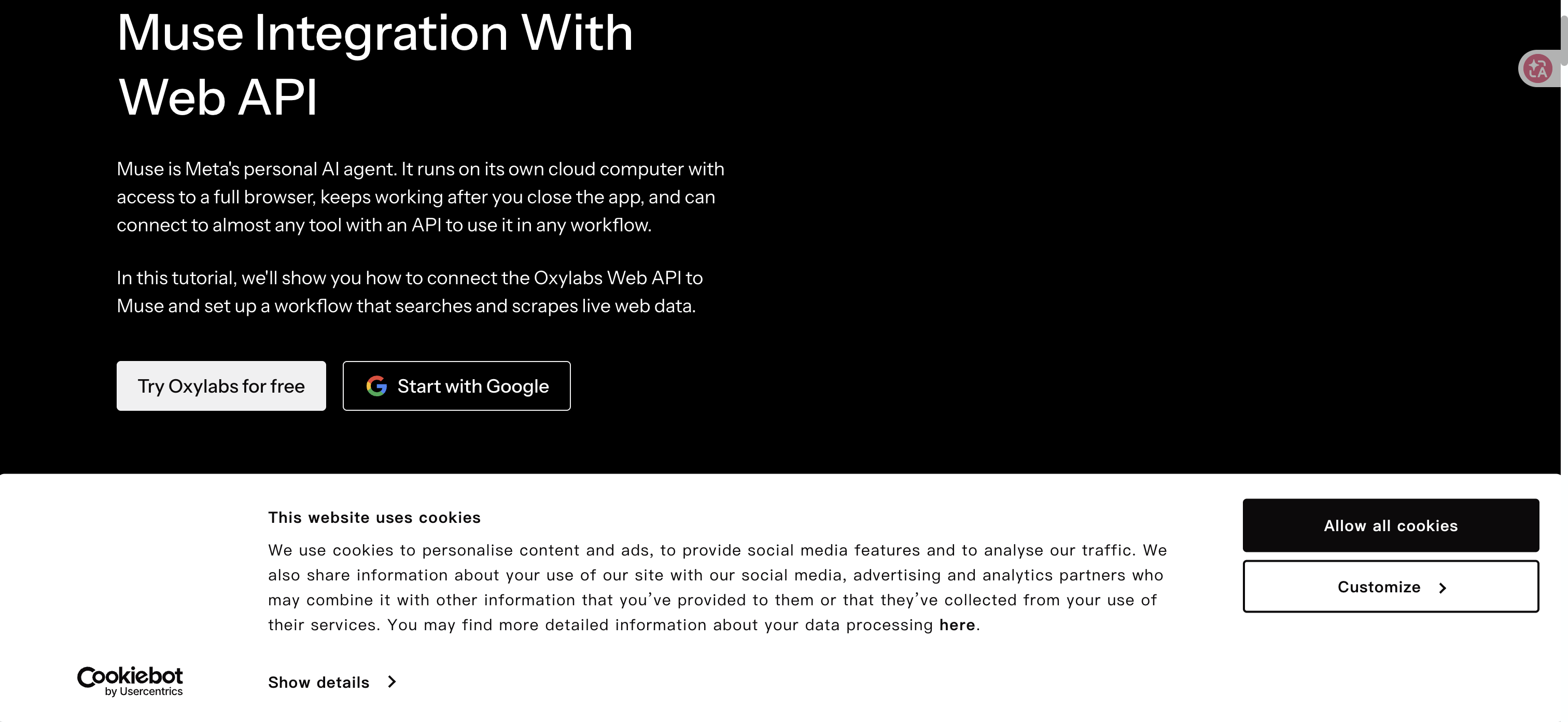
Oxylabs' own integration guide, checked October 29, 2026. The page documents a provider API example; it is not evidence of a test performed for this article.
Define What a Successful Dataset Must Contain
Specify the unit of work
Start with the record you want, not the amount of prose you expect. A product listing, an event exhibitor and a business location are different units. State the source set, inclusion rules, date range and required fields before running anything.
For a proposed public product-listing pilot, you might choose five known pages and require product name, displayed price, currency, availability text, source URL and capture time. Five is an editorial suggestion for an inspectable pilot, not an observed Muse capacity. Keep a fixed sample so that you can compare the returned rows with pages you can inspect yourself.
Define the output at the same time. If the downstream team needs one row per listing in CSV, a paragraph describing five listings does not meet the requirement. A file named report.csv still needs to be opened and checked for columns, encoding and actual rows.
Make missing values explicit
An empty price can mean the site omitted it, the page required a location, access failed or the collector missed the element. Those conditions lead to different decisions. Preserve a raw value and a status rather than substituting a likely number.
Field | Why it belongs in the record |
source_url | Identifies the page behind the row |
captured_at | Records when collection occurred, with timezone |
raw_value | Preserves what was actually displayed |
normalized_value | Supports comparisons after an explicit transformation |
collection_status | Distinguishes collected, missing, restricted and failed cases |
notes | Explains conditions such as selected location or account context |
A Small Evaluation That Exposes Useful Failures
Prepare a reference set you can inspect
Choose authorized public pages with known answers. Include the page types your real process depends on: perhaps a simple listing and a detail page that requires JavaScript. Avoid making the first pilot depend on purchasing, changing an account or collecting sensitive personal information.
Record expected pages and required fields before the run. This prevents the answer from defining its own success criteria. If you expect a known set of records, coverage is returned eligible records divided by expected eligible records. Calculate it only when that denominator is known. Open-ended web discovery usually lacks a reliable total.
Then choose the route from the earlier table. Keep the route and configuration fixed during the pilot. A change in source location, API endpoint or account can explain output differences that otherwise look like model inconsistency.
Review the actual deliverable
After a run, check the file and its sources. Confirm that URLs resolve to the intended pages, values match the source at the stated capture time and duplicated records follow your deduplication rule. Inspect the records with missing fields rather than looking only at complete examples.
Use a simple acceptance record:
- Confirm the requested source set and route were used.
- Compare returned rows and fields with the reference set.
- Open the exported artifact and check the schema.
- Record failed or restricted sources with their status.
- Decide whether to correct the workflow, narrow the scope or use another route.
These are proposed evaluation steps. There are no measured pass rates, elapsed times or row counts from a Muse run in this article.
Pro Tip: Keep the rejected output as well as the accepted version. It shows whether a correction fixed retrieval, normalization or only the wording of the summary.
Repeat before scheduling
A successful first run gives you an example to inspect. It does not establish recurring reliability. Repeat the same task on another occasion and compare schema, source coverage and failure handling. Also verify how the process reports a failed run: silence should not look like a clean dataset with no changes.
Choose your own acceptance and stop thresholds before expanding. A financial reporting process will need different controls from an exploratory content brief. Avoid borrowing a claimed success rate from an unrelated website or provider demonstration.
Access, Permissions and Website Content Still Matter
Keep collection separate from consequential actions
Meta's connector guidelines distinguish reads, writes and sensitive writes. They describe per-use approval for sensitive writes and recommend offering read-only OAuth scopes where possible. Those are documented platform controls; they do not establish the correctness of every custom workflow.
For a web-data evaluation, request collection and export only. Keep purchases, messages, public posts and account changes outside that task. If sign-in, identity checks or a site restriction interrupts collection, record the boundary and use the approved recovery route. Do not turn a research request into a permission to change account settings.
The safety architecture also acknowledges that agents can make mistakes and encounter malicious instructions in retrieved material. A page's text is source content, not authority to change your task. Review unexpected requests to share files, expose credentials or take unrelated actions.
Verify current access on your own sources
A product announcement cannot guarantee another website's access policy. Nor does one blocked page prove that every page or every later attempt will fail. Keep the date, route and observed status attached to the finding.
If the target service provides an authorized export or API, assess that option first. It can give the dataset a clearer schema and scope. Browser access remains useful where the required information is available through the permitted interface, but availability and completeness still need verification.
When a Reusable Collection Bot Fits Better
Separate recurring retrieval from analysis
A task becomes a collection operation when the same source set, fields and delivery rules return repeatedly. At that point, evaluate a process whose output can be inspected separately from an agent's written explanation.
BrowserAct lets you describe a web-data requirement in natural language and build a reusable collection Bot. Its current product description includes browser infrastructure, CSV or JSON delivery and scheduling. A proposed Bot still needs a successful run, a checked output and source-specific validation before you depend on it.
This is a workflow design option, not a verified Muse integration. No native BrowserAct–Muse connector or automatic end-to-end transfer was tested for this article. You can evaluate collection and analysis as separate stages, then decide how an approved file should move between them.
Pro Tip: Keep a stable schema version on repeated exports. If a field changes meaning, rename or version it rather than quietly mixing incompatible values in the same column.
Decide on the Deliverable You Can Verify
Muse AI scraping deserves evaluation when an agent can help define a question, coordinate an authorized retrieval route and explain the resulting data. The decision rests on the actual pages, returned rows and exported artifact. Browser access, a connected API and a scheduled task are intermediate states.
For a one-off research question, a compact source-backed answer may be enough. For recurring collection, require a stable data contract and visible failure reporting. If the main need is a reusable collection process, explore BrowserAct's Bot approach and validate it against the same source set before expanding.
Frequently Asked Questions
Can Muse AI scrape websites?
Meta documents browser access and custom connectors. A specific website, field set and export still need testing; documented browsing does not prove universal scraping reliability.
Is Muse AI scraping the same as using a scraping API?
No. An external API supplies the retrieval layer, while Muse can coordinate requests and interpret results. Evaluate the provider's access, costs and output separately.
Can Muse export scraped data as CSV?
Oxylabs documents CSV output in its own Muse API tutorial. That provider example does not establish that every native browser task or account produces the same export.
Does this article report a hands-on Muse scraping test?
No. It reviews current official documentation and a provider tutorial, then proposes an acceptance plan. No extraction benchmark was run for this article.
What should I check before scheduling web collection?
Check the source set, required fields, missing-value states, exported file and repeat-run behavior. Define your acceptance criteria and failure notification before expanding.
Is there a verified BrowserAct connector for Muse?
No native connector was verified for this article. BrowserAct can be evaluated separately for reusable web collection; any transfer into Muse needs its own validation.


