Kimi K3 Shows the Next AI Agent Bottleneck: Browser Execution

Kimi K3 is the kind of AI release that makes Silicon Valley stop scrolling. Moonshot AI’s new model is being discussed as a 2.8-trillion-parameter open-weight system with a 1-million-token context window, built for long-horizon coding, knowledge work, visual understanding, and agentic tasks. Reuters framed Kimi K3 as one of China’s most ambitious open AI releases yet. AP said the model took the U.S. tech industry by surprise. Business Insider rounded up reactions from investors, academics, and o
- 1Kimi K3 matters because it pushes the AI conversation from model benchmarks toward agentic workflows.
- 2Stronger reasoning models expose a different constraint: agents still fail when they have to operate real websites.
- 3Browser execution is becoming a core layer of the agent stack, not a nice-to-have scraping utility.
- 4BrowserAct fits this gap by giving AI agents real browser access, live web data extraction, authenticated workflows, and human handoff.
- 5The teams that win with AI agents will combine frontier models with reliable web execution, evidence, and reusable workflows.
Kimi K3 is not just another large model
The headline number is huge: 2.8T parameters.
But the model size is not the only reason Kimi K3 matters. The more interesting part is what the model is built to do.
According to Reuters and AP coverage, Kimi K3 is positioned around advanced reasoning, long-horizon coding, and knowledge work. Decrypt reported that it performed strongly on frontend coding and benchmark tasks. Business Insider highlighted the broader reaction from U.S. tech leaders who see the release as part of a bigger shift: China’s open models are becoming serious competitors to closed frontier systems.
That matters because the language around model releases is changing.
A year ago, most model launches were evaluated with familiar questions:
- Is it better at math?
- Is it better at coding?
- How long is the context window?
- Is it cheaper per million tokens?
- Does it beat GPT or Claude on benchmarks?
Those questions still matter. But the market is now asking a more practical one:
Can this model help an agent finish real work?
Kimi K3 is being discussed in that context — not only as a chatbot, but as a model for coding agents, research agents, enterprise knowledge work, and multi-step task execution.
That is a different game.
What is the AI agent execution layer?
The AI agent execution layer is the infrastructure that lets a model act in real software environments instead of only generating text. For web-based work, that means opening browsers, using authenticated sessions, interacting with dynamic pages, collecting live data, and verifying outcomes.
A model can plan the task. The execution layer performs it.
This distinction is becoming more important as models improve. When models were weaker, the limiting factor was intelligence. The model could not reason through the task.
Now, models can often produce a reasonable plan. They can write the script. They can explain the workflow. They can break the task into steps.
But the plan still collapses if the agent cannot operate the web.
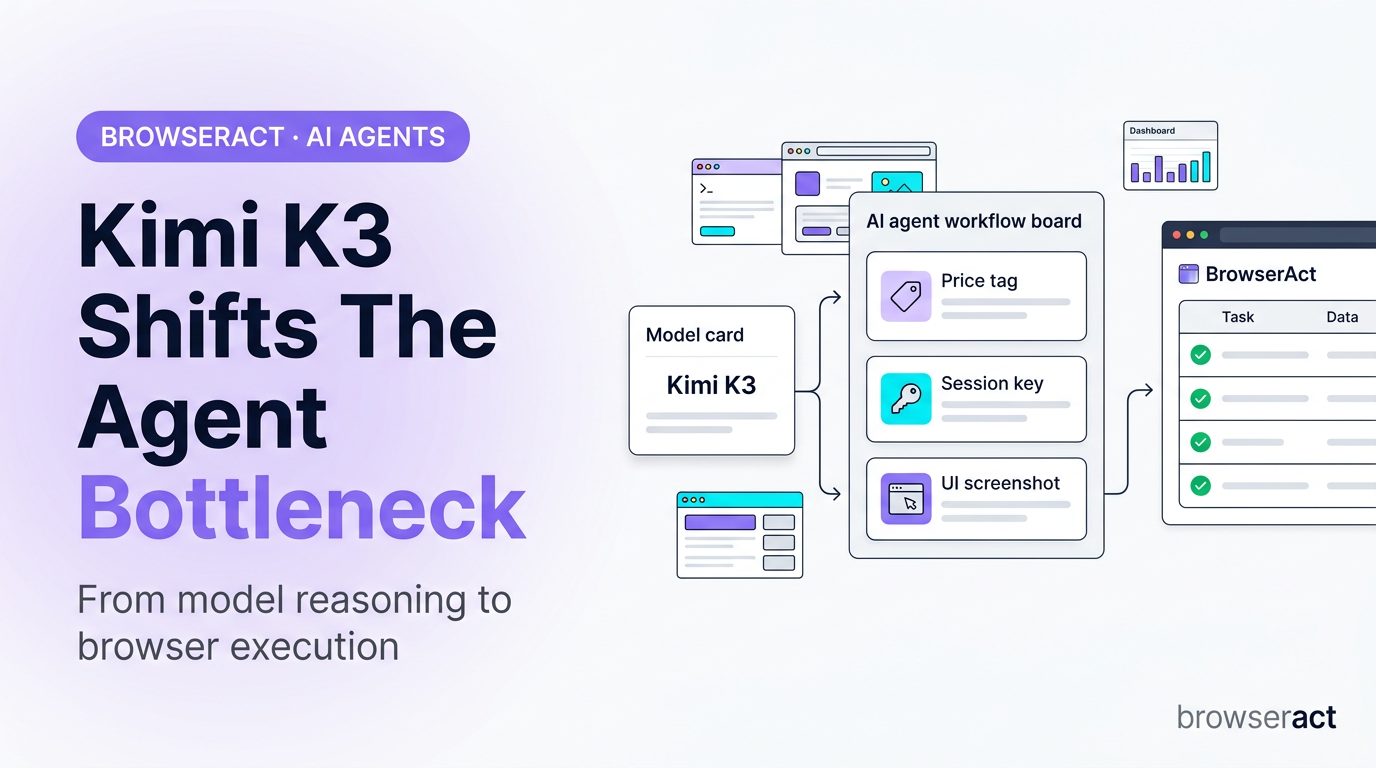
The agent bottleneck has moved from reasoning to the browser
Take a simple example.
You ask an agent to monitor three competitors after a major AI model release. The agent needs to check pricing pages, changelogs, docs, product announcements, GitHub repos, X posts, LinkedIn updates, Product Hunt pages, and maybe a few Discord or forum threads.
The model can understand the task.
The hard part is everything after that:
- Some pages render data through JavaScript.
- Some pages require login.
- Some pages lazy-load results after scroll.
- Some pages change their DOM every few weeks.
- Some pages block obvious automation.
- Some pages need a human to approve login or 2FA.
- Some sources have no clean API.
- Some information is only visible after clicking filters or tabs.
This is why “just give the agent a better model” is not enough.
A stronger model makes the plan better. It does not automatically make the browser layer reliable.
If your agent workflow depends on live web data, test it against logged-in, JavaScript-heavy, and anti-bot-protected pages before you judge the model. Most failures that look like “bad reasoning” are actually browser execution failures.
Why China’s model surge makes this more urgent
Kimi K3 is not happening in isolation.
Chinese AI labs are releasing larger, cheaper, and more agent-oriented models at a fast pace. Kimi K3 is the most visible current example because overseas media has covered it heavily. Reports around Alibaba’s Qwen roadmap, DeepSeek’s next release, and MiniMax’s upcoming models point in the same direction: the frontier is getting more crowded, more competitive, and more open.
For builders, that is good news.
More strong models means more choice. Lower-cost models make agent workloads more practical. Open-weight models give teams more control over deployment, fine-tuning, and data boundaries.
But it also raises the bar.
If everyone can access stronger reasoning models, the differentiator becomes the system around the model.
That system includes:
- tool orchestration
- memory
- evaluation
- live data access
- browser automation
- human approval
- workflow reuse
- observability
The model is becoming one layer in a larger agent stack.
The wrong way to think about agentic AI
The wrong mental model is simple: better model equals better agent.
That sounds reasonable until the agent has to touch the real web.
Old assumption | Reality in agent workflows |
Better model = better agent | Better model improves planning and reasoning, not web reliability |
Web data is easy to fetch | Modern pages are dynamic, authenticated, and protected |
APIs cover most use cases | Many useful business signals never appear in clean APIs |
Browser automation is a script problem | Production browser work needs sessions, resilience, and verification |
Agents can run unattended | Sensitive steps still need human approval |
Why this mistake gets expensive
This is the part many AI teams underestimate.
They evaluate models on coding benchmarks, then assume the same model will reliably run a market research, sales ops, or competitive intelligence workflow.
But the web is not a benchmark.
It is messy. It changes. It blocks. It asks you to log in. It hides data behind clicks. It rate-limits. It shows different content depending on geography, account state, and device fingerprint.
That is why the next agent stack needs a reliable browser execution layer.
Give your agent a real browser, then turn the workflow into a Skill.
- 1. Use browser-act when an agent needs to open, click, scroll, extract, or inspect a live site.
- 2. Use browser-act-skill-forge when the workflow should become reusable across runs and agents.
- 3. Keep the operational boundary simple: automate what the user can already do in the browser.
Where BrowserAct fits
BrowserAct is built for the layer that comes after the model decides what to do.
It gives AI agents a way to work with real websites:
- open browser sessions
- operate JavaScript-rendered pages
- reuse authenticated browser state
- extract live web data
- handle multi-step workflows
- pause for human takeover when needed
- return structured results and evidence
- turn repeatable browser tasks into reusable skills
This matters because the model race is moving toward agentic work.
A model like Kimi K3 can plan a research workflow. BrowserAct helps the agent execute that workflow on the real web.
A model can decide that it needs competitor pricing data. BrowserAct can help collect it from live pricing pages.
A model can generate a frontend change. BrowserAct can help verify the page visually and interactively.
A model can summarize a market trend. BrowserAct can help gather fresh source material from news pages, docs, social platforms, and search results.
The model is the brain. BrowserAct is part of the hands and eyes.
Do not wire browser automation into an agent only as a last-mile scraping tool. Treat it as part of the agent’s reasoning loop. The agent should be able to inspect, verify, retry, and hand off — not just fetch HTML once.
Three workflows where this matters immediately
1. Competitive intelligence after AI releases
When Kimi K3, Qwen, DeepSeek, or MiniMax releases a new model, the market reaction does not live in one place.
It spreads across official blogs, benchmark sites, GitHub, Hugging Face, X, LinkedIn, Reddit, Hacker News, product docs, pricing pages, and analyst coverage.
A useful agent needs to collect those signals continuously.
BrowserAct can support this kind of workflow by giving the agent real browser access and live data extraction. For teams tracking announcements and media coverage, a source like the Google News API Skill can also become part of the data pipeline.
2. Sales and marketing research
A go-to-market agent should not rely on stale company summaries.
It should inspect a prospect’s website, open product pages, find current positioning, read recent news, check hiring signals, and identify relevant social profiles.
That requires live web interaction. A template like BrowserAct’s Social Media Finder is useful because it turns a messy discovery task into a repeatable workflow.
3. UI verification for coding agents
Kimi K3 and similar models are being evaluated heavily on coding and frontend work.
But generated code is not the final product. The rendered page is.
A coding agent needs to open the page, click buttons, fill forms, verify layout, check screenshots, and catch visual regressions.
This is where browser execution becomes part of the development loop rather than a separate QA task.
For coding agents, browser verification should happen before the agent says “done.” If the agent cannot open the page and prove the workflow works, the task is not complete.
The practical checklist for agent builders
If you are building with Kimi K3, Qwen, Claude, GPT, DeepSeek, or any other frontier model, ask these questions before you call the agent production-ready:
- Can the agent access authenticated websites without exposing credentials?
- Can it handle JavaScript-rendered pages?
- Can it collect live data, not just summarize training knowledge?
- Can it recover when selectors or page layouts change?
- Can it pause for human approval on sensitive steps?
- Can it provide screenshots, logs, or structured evidence?
- Can a successful workflow be reused without re-prompting from scratch?
- Can it run the same workflow repeatedly on a schedule?
If the answer is no, your bottleneck is probably not the model.
It is the execution layer.
Sources and further reading
- Reuters via Investing.com: Moonshot unveils Kimi K3
- AP: Chinese AI model takes US tech industry by surprise
- Business Insider: Reactions to Kimi K3
- Decrypt: Kimi K3 benchmark coverage
- Kimi K3 launch brief: Kimi K3 overview
Conclusion
Kimi K3 proves that the model frontier is getting more competitive. But for teams building AI agents, the lesson is not simply “try the latest model.”
The lesson is that stronger models make weak infrastructure more visible.
A weak model fails before the browser step. A strong model gets far enough to expose the browser step.
That is why browser execution is becoming a core part of the agent stack.
If the model can reason but cannot access the live web, the agent is trapped in the chat box. If it can plan but cannot verify, the output still needs a human to redo the work. If it can write code but cannot test the UI, the task is only half finished.
The next generation of AI agents will need both frontier models for reasoning and reliable browser execution for real-world work.
If your team is experimenting with Kimi K3, Qwen, Claude, GPT, or DeepSeek for agentic workflows, the next question is simple: can your agent reliably use the web?
Give your AI agents real browser access with BrowserAct.
Two Skills, One Repeatable Browser Workflow
Start with live browser execution when the agent needs to understand a page. Move to Skill Forge when the same scraper should run again without re-exploring the site.
Run once with browser-act
Give Codex, Claude Code, Cursor, Windsurf, or another agent a real browser for rendered pages, clicks, scrolling, screenshots, DOM extraction, and network inspection.
Open browser-act SkillPackage with Skill Forge
Explore the site once, verify the extraction path, then generate a callable Skill package that other agents can reuse for batch jobs or scheduled workflows.
Open Skill ForgeFurther reading: Coding agent integrations
Frequently Asked Questions
What is Kimi K3?
Kimi K3 is Moonshot AI’s open-weight AI model, widely reported as a 2.8T-parameter system built for coding, reasoning, knowledge work, and agentic tasks.
Why does Kimi K3 matter for AI agents?
It shows that frontier models are increasingly optimized for long-horizon tasks, which makes reliable execution infrastructure more important.
What is a browser execution layer?
It is the system that lets an AI agent open websites, use sessions, interact with pages, extract live data, and verify task completion.
Why can’t a stronger model solve browser automation by itself?
Reasoning helps the agent plan, but real websites still require sessions, JavaScript rendering, anti-bot handling, clicks, verification, and human approval.
How does BrowserAct help AI agents?
BrowserAct gives agents real browser access, live web data extraction, authenticated workflows, human handoff, and reusable browser skills.
Should teams use BrowserAct with Kimi K3 or other models?
Yes, if the agent needs to operate real websites, collect current data, verify UI, or complete multi-step web workflows.


