How to Monitor Reddit for Competitor Complaints Without Cherry-Picking

A Reddit post saying a competitor “sucks” is not yet competitive intelligence. You need to know what failed, in which workflow, under what conditions, whether other users reproduced it, what the author tried, and whether the complaint led to a switch. You also need the comments that disagree, explain a workaround, or show that the competitor solved the issue. The useful path is: text competitor mention → verified complaint → recurring pattern → tested response This guide shows how to collect com
Define a complaint as a failed expectation
A negative word is not enough. A useful complaint describes the gap between what the user expected and what happened.
Capture:
- competitor and product;
- user goal;
- expected behavior;
- observed behavior;
- affected feature or workflow;
- conditions, plan, device, integration, or scale when stated;
- consequence;
- workaround or attempted fix;
- support interaction when relevant;
- whether the issue remains unresolved;
- whether the user is evaluating a switch.
Use controlled categories:
Complaint type | Evidence to look for | Possible use |
Product failure | Crash, data loss, incorrect output, outage, unreliable behavior | Product gap hypothesis or sales objection research |
Performance/reliability | Slow, intermittent, rate-limited, unstable | Segment and scale comparison |
Usability/complexity | Setup, navigation, configuration, learning curve | UX and onboarding differentiation |
Missing capability | Feature, workflow, integration, export, API limitation | Product discovery |
Pricing/billing | Price rise, surprise charge, limit, packaging mismatch | Pricing and packaging research |
Support/service | Slow response, unresolved ticket, inconsistent guidance | Service-positioning research |
Migration/lock-in | Export difficulty, data portability, contract or setup cost | Migration content and tooling |
Trust/policy | Privacy, transparency, enforcement, account access | Risk and trust research |
general_negative_opinion as a category. It prevents vague dislike from being forced into a more specific failure.
Build one query family per competitor
Start with the competitor's:
- company and product names;
- domain;
- abbreviations and common misspellings;
- plan names;
- branded features or integrations;
- legacy names only when they still create relevant matches.
Combine those identifiers with complaint families.
Reliability and product failure
broken, bug, crash, outage, unreliable, slow, failing, lost data, wrong result
Pricing and billing
too expensive, price increase, billing, charged, credits, limit, paywall, renewal
Support and service
no response, support ignored, ticket, refund, cancelled, account locked
Missing capability and integration
missing, wish, does not support, integration, API, export, import, sync
Switching and migration
alternative to, switching from, moved from, migrate away, replace, cancel
Comparison
versus, vs, better than, worth it, recommend instead
Keep broad brand mentions in a separate discovery query. Do not mix them into the high-priority complaint alert.
Separate complaints from the events that may explain them
A price complaint becomes more useful when you can verify that the competitor changed a public plan. An outage complaint becomes stronger when several independent threads describe the same window. A missing-feature complaint may be obsolete if current documentation already shows the feature.
For each pattern, record whether the explanation is:
- confirmed by the competitor's public pricing, documentation, status page, release note, or policy;
- corroborated by independent Reddit records;
- contradicted by current product evidence;
- based only on one user's account;
- unknown and awaiting verification.
Keep page-change monitoring separate from conversation monitoring. One tells you what the competitor published; the other tells you how users experienced it.
Collect posts and comments together
The post usually states the complaint. Comments reveal whether it is reproducible, caused by configuration, already resolved, limited to one plan, or part of a broader pattern.
Store:
post_id
comment_id
parent_comment_id
canonical_url
Preserve author updates. A later edit saying “support fixed it” materially changes the status even though the original complaint remains useful evidence.
Build the collection in BrowserAct
BrowserAct's Reddit Competitor Analysis API currently combines keyword discovery with post and comment extraction. Its documented inputs include keyword, publication-date range, post sort, comment sort, and comment limit. Its output includes post metadata plus comment text, author, time, votes, nesting level, author URL, and reply target.
Use the template for structured source collection. The prompt below adds complaint verification, resolution state, corroboration, and counterevidence.
1. Open BrowserAct Dashboard
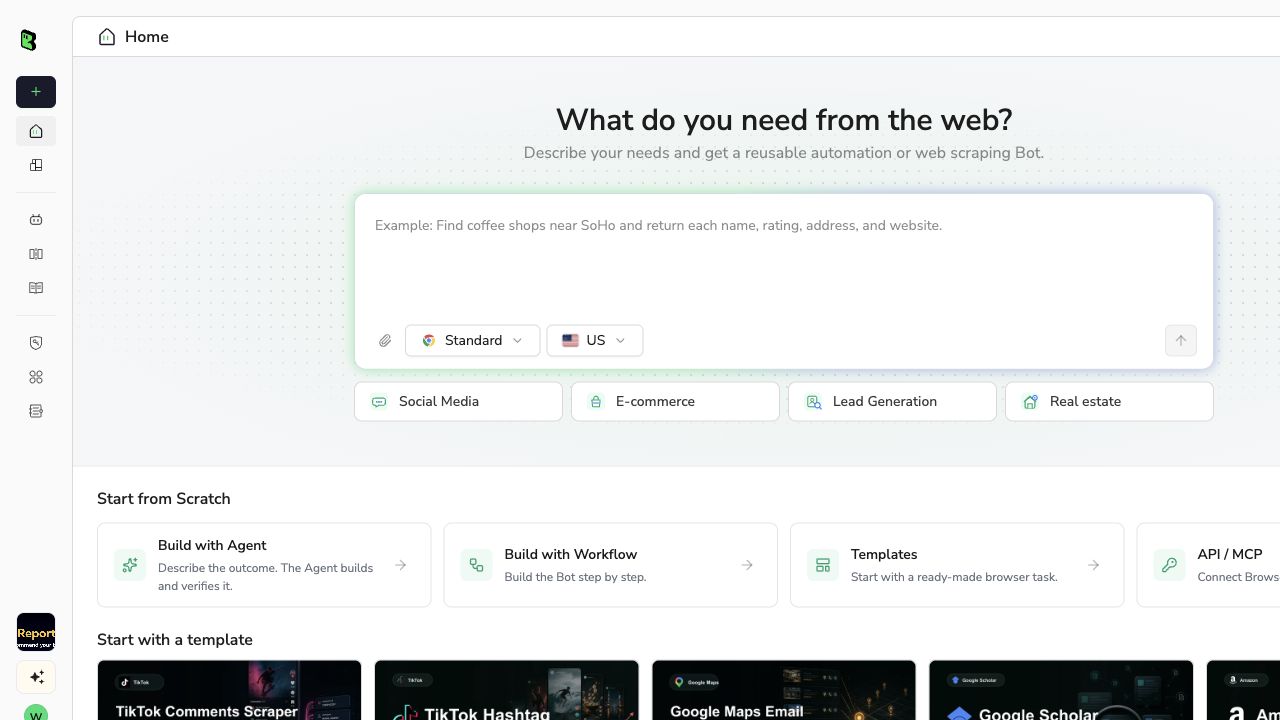
Open BrowserAct Dashboard and click the left-side + to create a Bot. Paste the prompt into the Agent input. You can also open the Reddit Competitor Analysis API template and select Run task after replacing the example competitor.
2. Copy the complete prompt
Replace the competitor profile and query families. Begin with one competitor and a narrow date range before increasing comment depth.
Create a reusable Bot that collects and verifies public Reddit complaint evidence about a competitor. Preserve posts, relevant comments, resolutions, contradictions, and exact source URLs. Do not turn every negative mention into a product gap or sales lead.

Inputs:
- monitor_id: reddit_competitor_complaints
- run_id: competitor_complaints_2026-09-18T00-00Z
- report_start_utc: 2026-09-11T00:00:00Z
- report_end_utc: 2026-09-18T00:00:00Z
- competitor:
  - competitor_id: competitor_a
  - names:
    - Example Competitor
    - examplecompetitor.com
  - products:
    - Example Product
  - plan_names:
    - Starter
    - Pro
  - branded_features:
    - Example Sync
- complaint_terms:
  - broken
  - crash
  - unreliable
  - slow
  - too expensive
  - price increase
  - billing
  - support
  - refund
  - missing
  - integration
  - export
  - alternative
  - switching from
  - migrate away
- search_targets:
  - target_id: product_failures
    source_url: https://www.reddit.com/search/?q=%22Example%20Competitor%22%20%28broken%20OR%20crash%20OR%20unreliable%29&sort=new
  - target_id: pricing_support
    source_url: https://www.reddit.com/search/?q=%22Example%20Competitor%22%20%28pricing%20OR%20billing%20OR%20support%29&sort=new
  - target_id: switching
    source_url: https://www.reddit.com/search/?q=%28%22alternative%20to%20Example%20Competitor%22%20OR%20%22switching%20from%20Example%20Competitor%22%29&sort=new
- max_posts_per_target: 30
- max_visible_comments_per_post: 30

For each target:
1. Open the exact public search URL and validate the expected Reddit view.
2. Keep results inside the report window; label older results as late discoveries.
3. Collect unique posts up to the target limit.
4. Open each post and collect visible comments needed to understand cause, reproduction, workaround, resolution, contradiction, or switching intent.
5. Exclude ads, navigation, suggested communities, unrelated pinned posts, and deleted text.
6. Continue healthy targets when one target fails.

Return one raw evidence record per post or comment with:
- evidence_id: reddit:post:<post_id> or reddit:comment:<comment_id>
- item_type
- post_id
- comment_id when applicable
- parent_comment_id when visible
- canonical_url or comment permalink
- subreddit
- title
- body
- parent_context when needed
- author when visible
- published_at_utc when reliable, otherwise published_time_raw
- collected_at_utc
- score when visible
- post_comment_count when visible
- matched_target_ids
- matched_terms

For each complaint candidate, return:
- competitor_id
- complaint_type: product_failure, performance_reliability, usability_complexity, missing_capability, pricing_billing, support_service, migration_lock_in, trust_policy, general_negative_opinion, irrelevant, or uncertain
- user_goal stated in the source
- expected_behavior stated or directly implied by the described workflow
- observed_behavior stated in the source
- affected_product_area
- conditions_or_segment stated in the source
- consequence stated in the source
- attempted_fix_or_workaround stated in the source
- support_interaction stated in the source
- resolution_state: unresolved, resolved, partially_resolved, stale, or unknown
- switching_state: actively_evaluating, considering, already_switched, no_switch_evidence, or unknown
- evidence_sentence: short factual paraphrase grounded in visible text
- specificity: high, medium, or low
- severity: blocking, major, minor, or unknown
- confidence: high, medium, or low

Corroboration rules:
- Exact duplicate evidence IDs merge across targets.
- Different authors describing a similar issue remain separate evidence records.
- Create a candidate_pattern_id only when records share competitor, product area, failed expectation, and materially similar conditions.
- Preserve supporting_evidence_ids and contradicting_evidence_ids separately.
- Praise or successful-workflow comments relevant to the same product area are counterevidence, not noise.
- A single complaint remains one-off evidence until independently corroborated.
- Do not divide complaint count by an unknown customer base or claim a failure rate.

Qualification rules:
- Negative tone alone is general_negative_opinion.
- Do not infer plan, customer status, company size, revenue, location, or churn unless stated.
- Do not treat an already-switched user as an open lead.
- Do not claim the competitor removed or changed a feature unless public evidence or the source supports it.
- Do not interpret upvotes as prevalence.
- Route ambiguous, severe, legal, security, privacy, or low-context claims to human review.

Return:
1. raw_evidence_records;
2. verified_complaint_candidates;
3. candidate_patterns with supporting and contradicting evidence IDs;
4. switching_review_queue;
5. human_review_queue;
6. source_health for every target;
7. exact_duplicate_log;
8. method note describing date, sort, and comment-depth limits.

Use public or authorized pages only. Do not vote, join, post, reply, message users, or change an account. If Reddit requests login, CAPTCHA, 2FA, age confirmation, membership approval, or restricted access, pause that target and ask me to complete it manually.
Keep the complaint and your interpretation in separate fields. A reviewer must be able to see what the source said before accepting the proposed pattern.
Scrape data from any website. Describe the evidence you need and turn the task into a reusable Bot. Try: “Collect recent posts and comments about this competitor, separate vague dislike from a failed expectation, and retain both corroborating and contradicting evidence.” Get your Bot — Free
3. Handle login only when asked
The workflow targets public or authorized Reddit content. If Reddit asks for login, CAPTCHA, 2FA, age confirmation, membership approval, or restricted access, pause that target for manual handling.
Record the incomplete source. Do not report fewer complaints as an improvement when coverage fell.
4. Review, dedupe, and export
Test a mixed sample before scheduling:
- a detailed unresolved product failure;
- vague negative sentiment without a failed expectation;
- a pricing complaint tied to a named plan or change;
- a support complaint that later shows resolution;
- a missing feature with a current workaround;
- an explicit switch request;
- an already-completed switch;
- praise or contradiction in the same product area;
- a duplicate post matched by several queries;
- an ambiguous high-severity claim requiring review.
Open every linked source. Confirm category, resolution state, switching state, conditions, evidence sentence, and counterevidence. Export raw evidence, verified complaints, candidate patterns, switching review, human review, source health, and duplicates separately.
Move through four evidence levels
Do not call a single thread a market pattern.
Level | Evidence | Allowed conclusion |
Observation | One post or comment | “One user reported…” |
Corroborated issue | Independent records with the same failed expectation and similar conditions | “Several independent users described…” |
Recurring pattern | Repeated across time, threads, or communities with stable definition | “A recurring complaint pattern is…” |
Validated competitive gap | Reddit pattern plus current product/pricing/docs evidence and relevant internal data | “This gap is worth testing in product or positioning…” |
Normalize the problem without erasing conditions
“Too expensive” can mean:
- price exceeds the user's budget;
- a feature moved to a higher plan;
- usage-based charges are unpredictable;
- the product is poor value for one workflow;
- a discount expired;
- billing was incorrect.
Those are different problems. A useful pattern statement names the condition:
Small teams with irregular usage report difficulty predicting monthly cost
after usage-based limits, and several describe evaluating fixed-price alternatives.
Do not collapse it into “Competitor A has bad pricing.”
Preserve contradictions and praise
For every proposed pattern, search within the collected comments for:
- users who cannot reproduce the issue;
- conditions under which the feature works;
- current fixes or documentation;
- users who prefer the competitor's approach;
- evidence that the complaint is limited to an old version or one plan;
- explanations that assign the cause elsewhere.
A pattern can remain valid while its scope narrows. That is better intelligence than a dramatic but false universal claim.
Separate switchers from completed churn
Use distinct states:
actively_evaluating: explicitly asks for alternatives or compares current options;considering: expresses desire to leave but no active evaluation evidence;already_switched: names a completed move;no_switch_evidence: complaint only;unknown: insufficient context.
An already-switched user is valuable win/loss evidence. They are not automatically a current sales opportunity.
Route each pattern to the right action
Product
Use recurring, specific problems as discovery inputs. Validate them against your target segment, current product behavior, support data, and strategy before adding a roadmap item.
Positioning and sales enablement
Turn verified decision criteria into factual comparison guidance. Do not claim the competitor “always fails.” State the condition you can prove and your own product's tested behavior.
Content and migration
Create helpful guides when users repeatedly ask how to export, migrate, compare plans, or evaluate tradeoffs. Include honest limitations and prerequisites.
Pricing and packaging
Study the reason behind pricing friction: predictability, entry price, feature gating, perceived value, contract, or usage. Do not assume “cheaper” is the only response.
Research only
Archive one-off complaints, completed switches, and uncertain claims with their source links. They can become relevant if independent evidence appears later.
Do not attack the competitor in complaint threads
If a thread invites recommendations and your product genuinely fits, prepare a human-reviewed answer that:
- solves the immediate question first;
- discloses your affiliation;
- states the relevant capability and limitation accurately;
- avoids repeating unverified accusations;
- does not pile on to the complaint;
- does not send an unsolicited private message;
- follows the subreddit's self-promotion rules.
Often the right action is no reply. The evidence can still improve your product, comparison content, onboarding, or sales discovery.
Compare rates only when you know the denominator
Raw complaint counts are biased by:
- competitor size and active user base;
- Reddit audience overlap;
- launch or outage events;
- monitoring coverage;
- query breadth;
- time window;
- community activity;
- who is motivated to post.
Without a defensible denominator, compare themes and evidence strength rather than claiming that one competitor has a higher failure rate.
For time trends, keep the same targets, queries, date window, collection depth, and classification policy. Mark periods with incomplete coverage.
Review patterns on a fixed cadence
Use two queues:
- Immediate review: severe unresolved failure, security/privacy allegation, rapidly spreading pricing controversy, or explicit open switch evaluation.
- Periodic synthesis: recurring product, support, pricing, usability, and migration themes.
In the periodic review:
- inspect source health;
- verify new high-severity records;
- promote or demote candidate patterns;
- review contradictions and resolutions;
- compare with public competitor changes;
- validate against internal evidence;
- assign a product, positioning, content, pricing, or research action;
- record the decision and next review date.
Final checklist
Before using a competitor complaint as evidence, confirm that:
- it describes a failed expectation, not only negative tone;
- the competitor and product are unambiguous;
- the workflow and conditions are preserved;
- the source URL and comment relationship remain available;
- the resolution and switching states are separate;
- one-off evidence is not called a pattern;
- exact duplicates merge but independent reports remain separate;
- contradictory evidence and praise remain visible;
- public product, pricing, status, or documentation evidence is checked when relevant;
- complaint counts are not treated as failure rates without a denominator;
- product and positioning claims remain conditional and factual;
- any public response is human-reviewed, disclosed, and allowed by community rules.
Frequently asked questions
What competitor complaint keywords should I monitor on Reddit?
Combine competitor name variants with product-failure, reliability, pricing, billing, support, missing-feature, integration, export, cancellation, alternative, switching, migration, and comparison language.
Is every negative competitor mention a complaint?
No. Require a failed expectation or specific problem. Keep vague dislike as general negative opinion and exclude unrelated or promotional mentions.
How many complaints prove a competitor has a product gap?
No universal count proves it. Look for independent evidence with the same failed expectation and conditions, repeated over time, then validate against current public and internal evidence.
Is someone asking for an alternative automatically a lead?
It shows active evaluation, but your product must fit the stated requirements and the decision must still be open. Keep human review and subreddit rules in the loop.
Should we reply to competitor complaint threads?
Only when the thread invites relevant help, your answer can stand on its own, your product genuinely fits, and the community permits vendor participation. Disclose your affiliation and never send an unsolicited DM.


