How to Monitor Multiple Subreddits at Once Without Losing Context

Combining subreddit names into one feed is easy. Building a monitor that tells you what happened in each community is harder. If five communities share one collection limit and one baseline, a busy subreddit can fill the result window before a quieter niche community contributes a single row. When the combined run fails, you may not know which source was missed. A crosspost can look like one item or several, depending on whether you are measuring content reach or community activity. The reliable
Start with a community map, not a long subreddit list
Every monitored community should answer a research question. Group subreddits by the role they play in the market:
Community role | What it can reveal | Example selection test |
Category community | Shared tools, standards, and problems | Do target users discuss the product category here? |
Role community | Day-to-day language of a job or buyer | Does the role influence or use the solution? |
Technology community | Integration, implementation, and reliability issues | Does the monitored workflow depend on this technology? |
Alternative-method community | How people solve the job without your category | Does it reveal substitutes or workarounds? |
Competitor community | Product-specific experience and support patterns | Is it public, active, and relevant to competitive research? |
Regional or vertical community | Market-specific needs and constraints | Does geography or industry materially change the problem? |
Remove a subreddit when it consistently produces no relevant observations. Add one when useful posts repeatedly crosslink to it or customers name it as a trusted community. A smaller, explained source list is easier to defend than fifty communities chosen because their names looked related.
Give every subreddit its own source record
Create a source table before collecting posts:
Field | Example |
|
|
|
|
|
|
| Category community |
| Medium |
| 2 hours |
| 50 |
| Timestamp of the last valid run |
| Checkpoint for this community |
| Healthy, possible gap, failed, or access blocked |
last_seen_post_url for the entire project. Each subreddit moves at a different speed. A global checkpoint can make a quiet community look current even when it has not been collected for days.
The same rule applies to failures. If r/A succeeds and r/B fails, the combined job should be partially complete, with r/B marked failed. It should not report zero new posts for r/B or discard the valid r/A rows.
Collect separately, then normalize and merge
There are two common designs:
One combined feed
A URL such as /r/sub1+sub2+sub3/new/ or its RSS equivalent reduces the number of pages to watch. Current monitoring guides document this plus-sign syntax, and it can be useful for lightweight reading.
The trade-off is shared capacity. The busiest community can dominate the recent window. Source-specific failure, volume, and coverage become harder to diagnose. Use a combined feed when you want a reading inbox and can tolerate best-effort coverage.
Separate source runs
Visit each subreddit’s /new/ listing with its own limit, checkpoint, and status, then append valid rows to one normalized table. This requires more operations but protects small communities and makes gaps visible.
Use separate source runs for research, reporting, lead review, reputation monitoring, or any workflow where missing one community changes the conclusion. That is the design used in this article.
Define the shared post schema
Normalize field names after collection so every downstream filter sees the same structure:
source_id;subreddit;community_role;post_title;post_url;original_post_urlwhen the item is a crosspost;outbound_urlwhen it links off Reddit;published_at;collected_at;authorwhen visible;flairwhen visible;post_textwhen visible;scoreandcomment_countwhen visible;post_type;is_pinned;source_status;item_status.
Use UTC timestamps in storage and convert them only in the presentation layer. Keep raw visible values if a field cannot be normalized confidently.
Every row must preserve subreddit. Once source context is removed, the same sentence can be misread. A pricing question in a founder community and the same question in an enterprise-admin community may imply different needs.
Build a multi-subreddit monitor in BrowserAct
BrowserAct’s Reddit Community Intelligence Monitor is designed to enter relevant communities, sort posts by recent activity, and extract titles, publication times, Reddit URLs, full text, community information, and structured JSON. Its current page estimates 50–300 credits and describes integration with n8n, Make, and analytics tools.
For several communities, use the template as a repeatable source task. Give every subreddit the same output schema but a separate run state.
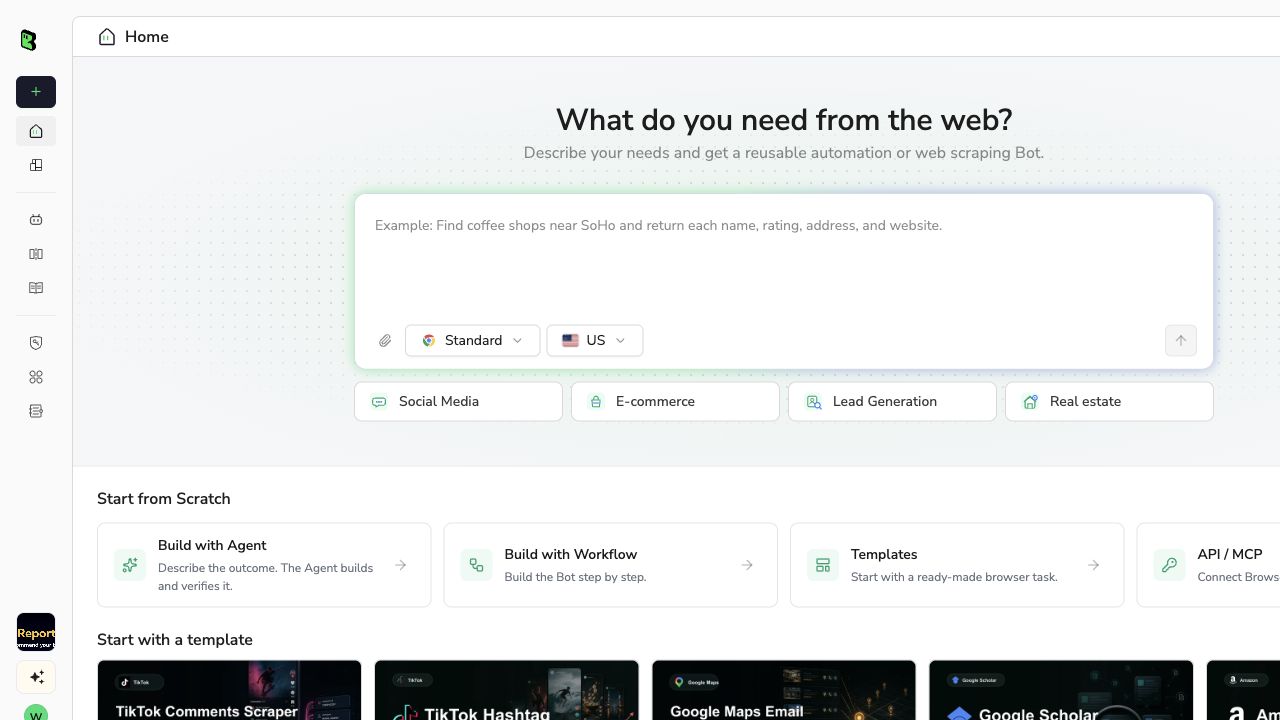
1. Open BrowserAct Dashboard
Click the left-side + to create a Bot, paste the prompt into the center Agent input, or open the template and select Run task.
2. Copy the complete prompt
Replace the example communities with your validated source list. Begin with three communities before expanding.
Create a reusable Bot that monitors multiple public subreddits for newly discovered posts while preserving separate state and health for each source.

Reusable inputs:
- subreddits:
  - source_id: community_saas
    subreddit_url: https://www.reddit.com/r/SaaS/new/
    community_role: category
    max_posts_per_run: 50
  - source_id: community_startups
    subreddit_url: https://www.reddit.com/r/startups/new/
    community_role: role
    max_posts_per_run: 25
  - source_id: community_entrepreneur
    subreddit_url: https://www.reddit.com/r/Entrepreneur/new/
    community_role: adjacent
    max_posts_per_run: 25
- previous_results: optional CSV or JSON from the last successful runs
- previous_source_state: optional source checkpoint table

For each subreddit separately:
1. Validate the exact public subreddit URL and keep the listing sorted by New.
2. Collect up to that source's max_posts_per_run actual posts.
3. Exclude advertisements, recommended-community cards, sidebar modules, and other non-post elements.
4. Record whether an older URL from that source's previous successful state was reached.
5. Continue to the next source if one source fails. Do not convert a failure into zero new posts.

Return these normalized fields for every post:
- source_id
- subreddit
- community_role
- post_title
- post_url
- original_post_url when visible for a crosspost
- outbound_url when visible
- published_at
- collected_at
- author when visible
- flair when visible
- post_text when visible
- score when visible
- comment_count when visible
- post_type when visible
- is_pinned when visible
- item_status: baseline, new, updated, or previously_seen

Deduplicate within each subreddit by canonical post_url. On later runs, compare each source only with its own last successful baseline. A known URL with changed tracked fields is updated, not new.

After all source runs finish, merge valid rows into one table. Preserve the subreddit permalink for every crosspost because posting the same source content into two communities is two community events. Add content_group_id when several rows share the same original_post_url or normalized outbound_url so analysts can review the spread without deleting the source events.

Return one source-health row per subreddit with:
- source_id
- subreddit_url
- run_started_at
- run_completed_at
- rows_collected
- new_rows
- updated_rows
- reached_previous_checkpoint
- health_status: healthy, possible_gap, failed, or access_blocked
- error_summary when applicable

Set possible_gap when a source reaches its collection limit before finding an older known URL. Set the overall run to partial_success when at least one source succeeds and at least one fails.

Use public or authorized pages only. Do not join communities, vote, comment, message users, or change any account. If Reddit requests login, CAPTCHA, 2FA, age confirmation, membership approval, or restricted access, pause that source and ask me to complete it manually.

Return:
1. a CSV-ready normalized post table;
2. JSON grouped by source_id;
3. a source-health table;
4. a run summary with total new rows and the list of failed or incomplete sources.
Do not delete crossposts blindly: one piece of content appearing in three communities is one content cluster and three community events. Keep all three rows and connect them with content_group_id.
Scrape data from any website. Describe the data you need. Get a Bot—a reliable, reusable scraper. Try: “Monitor these five subreddit New listings separately, preserve source health, and merge only validated new posts.” Get your Bot — Free
3. Handle login only when asked
The workflow targets public community listings. If one source shows a login, CAPTCHA, 2FA, age gate, membership approval, or restricted-access screen, pause that source for authorized manual handling and continue the sources that remain accessible.
Do not make the Bot join a community, vote, comment, send messages, or bypass a restriction. Record access_blocked rather than treating an inaccessible subreddit as a community with no new posts.
4. Review, dedupe, and export
Run three communities once to establish separate baselines. Verify:
- Each source-health row names exactly one subreddit.
- Every post row retains its source ID and subreddit.
- Limits are applied per community, not to one shared list.
- Pinned posts are marked and do not repeatedly appear as new.
- Crossposts retain their subreddit permalinks and share a content group only when supported by a common original or outbound URL.
- A simulated or real source failure produces partial success, not an empty successful source.
- UTC timestamps and canonical URLs are consistent.
Export the normalized post table, source-health table, and JSON. On the second run, supply the successful baseline for each source and confirm that new rows are evaluated against the correct community checkpoint.
The publication version should add a current BrowserAct result screenshot from a completed multi-source run. This review draft does not fabricate a merged result table.
Prevent large communities from drowning out small ones
Raw post counts reflect community volume, not necessarily importance. Keep at least three views:
View | Use |
Chronological inbox | Review all newly discovered posts by time |
Per-community queue | Guarantee that every source receives review capacity |
Normalized summary | Compare rates or shares within each community |
When comparing themes, calculate each theme’s share within a subreddit before aggregating. Ten pricing posts may be 50% of a small community’s weekly output but 1% of a large general-interest community. Present both raw counts and within-community proportions.
Do not use subreddit subscriber count as a quality score. Relevance, activity, community role, and the decisions supported by the data matter more.
Handle crossposts and repeated links correctly
Three identifiers answer different questions:
post_url: Which community event occurred?original_post_url: Was this Reddit item crossposted from another Reddit post?outbound_url: Do several posts link to the same external page?
Deduplicate exact collection repeats by post_url. Group related content by the original or outbound URL. This lets you say both “one article spread into four communities” and “four separate community discussions occurred.”
Do not merge posts only because their titles are similar. People often reuse generic titles, and titles can be edited.
Give every source an independent health status
The overall job should report:
success: all sources completed and passed validation;partial_success: at least one source succeeded and at least one failed or was blocked;failed: no source produced a valid result;possible_gap: one or more sources hit a limit before reaching their prior checkpoint.
At source level, retain the last successful run time. A dashboard showing “12 new posts” is incomplete without saying that two of eight communities failed.
Retry only the failed sources. Do not rerun healthy sources and resend their alerts. Give each delivery an idempotency key based on source, post URL, and alert type.
Assign cadence per community
One global schedule wastes resources on quiet communities and risks gaps in busy ones.
Observed source volume | Starting check interval | Per-run limit |
Fewer than 10 posts/day | Daily | 25 |
10–50 posts/day | Every 4–6 hours | 25–50 |
50–200 posts/day | Hourly | 50 |
More than 200 posts/day | Every 15–30 minutes | 50–100 |
Review the source map monthly. A community that changes rules, becomes private, goes inactive, or drifts off topic should be reclassified or removed rather than silently remaining in the monitor.
When a combined RSS feed is enough
Current guides document the public multi-subreddit pattern:
https://www.reddit.com/r/sub1+sub2+sub3/new/.rss
It is practical for a personal reading feed, a small set of similar communities, and best-effort discovery. It preserves the source subreddit on each item and reduces feed management.
Use separate BrowserAct source runs when you need full visible post text, custom fields, different limits or cadence per community, source-level health, crosspost grouping, and a dataset that can prove which communities were successfully checked.
The combined-feed shortcut and the separate-run design can coexist. Use the feed for human scanning and the structured workflow for auditable research.
Final checklist
- Select communities by role and research value.
- Start with five to ten subreddits.
- Give every source its own URL, limit, cadence, baseline, and health status.
- Collect each
/new/listing separately for dependable coverage. - Normalize fields only after source validation.
- Preserve subreddit context on every post.
- Deduplicate exact repeats by post URL.
- Group crossposts without deleting the separate community events.
- Report partial success and possible gaps visibly.
- Balance review capacity so large communities do not hide niche sources.
- Compare both raw counts and within-community proportions.
- Commit each source baseline only after its run succeeds.
- Keep monitoring separate from joining, voting, commenting, or messaging.
With this structure, a multi-subreddit monitor becomes a set of accountable sources rather than one opaque stream. You can see what is new, where it came from, which communities were actually checked, and whether repeated content represents duplication or genuine spread.
Frequently Asked Questions
Can I combine multiple subreddits into one Reddit feed?
Yes. Public combined URLs can join subreddit names with plus signs, and an RSS variant can provide a lightweight shared feed. Separate source runs provide stronger health and coverage evidence.
How many subreddits should I monitor first?
Start with five to ten communities selected for specific roles. Expand only after the team can review the volume and explain why each source remains useful.
How do I stop one large subreddit from dominating the results?
Use per-community collection limits and review queues, then compare both raw counts and within-community proportions.
Should crossposts be removed as duplicates?
Keep each subreddit permalink as a separate community event. Group rows by original Reddit post or normalized outbound URL when you also need a content-level view.
What happens when one subreddit fails?
Keep the successful sources, mark the overall run partial, preserve the failed source’s previous checkpoint, and retry only that source.


