How to Build an Automated Reddit Monitoring System That Does Not Fail Silently

An automated Reddit monitor is not a scheduled search with an alert attached. A production system has to remember what it has seen, distinguish a quiet day from a failed source, route urgent and routine findings differently, and prove that its output reached the destination. A workflow can finish with every node marked successful and still be wrong because it collected zero rows, reused stale state, or summarized an incomplete run. The system in this guide separates collection, state, qualificat
Start with one operational decision
Define what the monitor should help someone decide. Examples include:
- whether support needs to review a new brand complaint;
- whether sales should inspect a high-intent tool request;
- whether product should add a repeated pain point to weekly research;
- whether content should investigate a topic spreading across communities;
- whether competitive intelligence should review a cluster of switching complaints.
Do not begin with “monitor everything about our market.” That produces an unlimited source list, broad keywords, and no test for whether the output is useful.
Write the decision as a contract:
When a new public Reddit post or comment contains enough visible evidence of [signal],
create [immediate alert / review item / digest item] for [owner]
within [time target], and preserve the source URL and reason.
Every later rule should support that contract.
Use six layers with separate responsibilities
Keep the system modular:
Layer | Responsibility | Must not do |
Configuration | Stores sources, keywords, rules, owners, cadence, and version | Hold raw credentials in ordinary cells |
Collection | Retrieves public posts/comments and reports source access | Decide that a failed source had zero matches |
State | Matches identities, snapshots, checkpoints, and deliveries | Advance checkpoints after an incomplete run |
Qualification | Applies deterministic filters and AI-assisted labels | Hide uncertainty or invent missing context |
Delivery and reporting | Routes immediate alerts, review queues, and summaries | Mark an item delivered before receipt |
Health | Checks schedule, source coverage, output invariants, and destination success | Depend only on the workflow it is monitoring |
Create four durable tables before the workflow
Google Sheets can support a small proof of concept; a database is safer once concurrent runs, strict uniqueness, or frequent updates matter. In either case, keep these records separate.
Configuration table
One row per monitoring target:
Field | Example |
|
|
|
|
| Brand query or exact subreddit URL |
| Visible complaint plus product identifier |
| Careers, promotions, unrelated homonyms |
|
|
| Support operations |
|
|
|
|
Item table
One current row per canonical Reddit item:
monitor_id;item_type(postorcomment);item_idwhen visible;- canonical Reddit URL;
- source subreddit and parent URL;
- title or comment text when permitted;
- author when visible;
- published and first-seen timestamps;
- latest-seen timestamp;
- current score/comment count when relevant;
- content hash;
- status (
baseline,new,updated,previously_seen).
Enforce uniqueness on (monitor_id, item_type, item_id), with a normalized URL hash only when a stable ID is unavailable.
Append every valid collection to a raw snapshot archive keyed by run_id and item identity. The item table holds the latest operational state; the archive preserves the observations needed to recalculate changes, debug mappings, or reproduce a summary.
Run table
One row per execution:
run_idandmonitor_id;- scheduled, started, and completed times;
- policy version;
- sources expected, attempted, succeeded, failed, and blocked;
- rows collected, new, updated, qualified, alerted, and summarized;
- previous checkpoint reached;
- outcome (
success,partial_success,failed,possible_gap); - error summary and retry lineage.
This table answers whether the monitor ran and whether it produced a trustworthy result.
Delivery table
One row per external effect:
- deterministic
delivery_id; - item or summary ID;
- destination and delivery type;
- status (
pending,delivered,retryable,permanent_failure); - attempt count;
- destination receipt ID;
- delivered time and last error.
Collection deduplication and delivery deduplication are different controls. Keep both.
Design the run as a state machine
A scheduled run should move through explicit states:
scheduled → collecting → collected → normalized → qualified → routed → verified
                 ↘ partial_success / possible_gap / failed ↗
Only a verified source collection can advance that source’s successful checkpoint. An overall partial_success run may commit valid rows and checkpoints for its verified sources, while every failed source keeps its earlier checkpoint. A fully failed run preserves all prior successful state.
Prevent overlapping executions for the same monitor_id, or use a lease with an expiry time. Without a lock, two runs can discover the same item before either writes state and both can create an alert.
Assign a stable run_id before collection. Propagate it through BrowserAct output, classification, storage, alerts, and summaries so every result can be traced back to one execution.
Build the collection layer in BrowserAct
BrowserAct’s Reddit Intelligence Monitor is currently described as an n8n-based workflow that reads keywords and competitor subreddits from Google Sheets, uses BrowserAct for collection, processes and summarizes posts with AI, and stores structured reports in Google Sheets on a schedule.
Its current page provides the broad workflow. The prompt below adds source-specific state, partial-failure handling, and evidence fields needed for a monitor that can be audited.
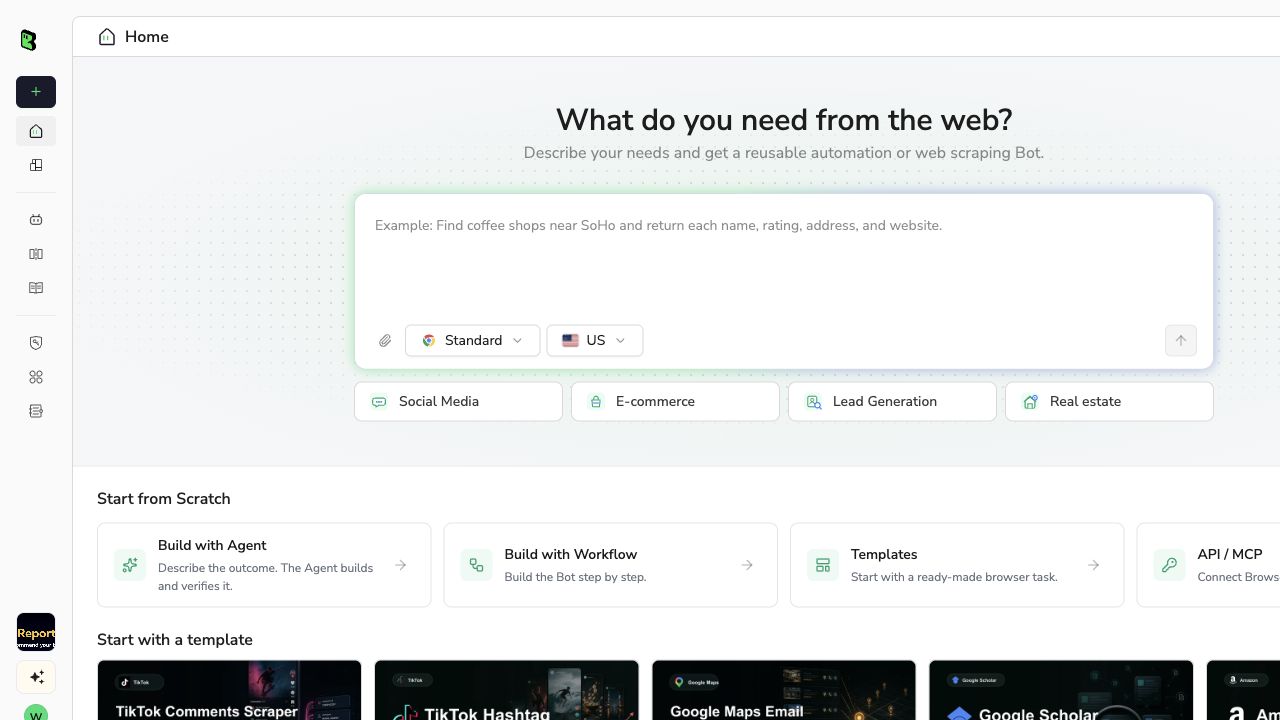
1. Open BrowserAct Dashboard
Click the left-side + to create a Bot, paste the prompt into the Agent input, or open the Reddit Intelligence Monitor template and select Run task.
2. Copy the complete prompt
Start with one decision, three to five sources, and a small result limit. The orchestrator should supply the run and configuration values.
Create a reusable BrowserAct Bot that performs the collection stage of an automated public Reddit monitoring system. Return source evidence and health separately from downstream classification and delivery.

Reusable inputs:
- run_id: supplied by the orchestrator
- monitor_id: reddit_monitor_example
- policy_version: v1
- targets:
  - target_id: keyword_reddit_monitoring
    source_type: keyword_search
    source_url: https://www.reddit.com/search/?q=%22reddit%20monitoring%22&sort=new
    max_items: 50
  - target_id: community_saas
    source_type: subreddit
    source_url: https://www.reddit.com/r/SaaS/new/
    max_items: 50
- previous_item_state: optional CSV or JSON from the last successful run for each target
- previous_source_state: optional target-level checkpoint and health table

For every target independently:
1. Open the exact public URL and verify that the expected Reddit listing or search page loaded.
2. Collect actual post cards up to that target's max_items.
3. Exclude advertisements, navigation, suggested communities, sidebar modules, and unrelated pinned announcements.
4. Preserve target_id and source_type on every row.
5. Record whether the target reached an item from its previous successful coverage.
6. Continue other targets when one target fails. Do not translate a failed or blocked source into zero new posts.

Return these normalized fields for every post:
- run_id
- monitor_id
- policy_version
- target_id
- source_type
- item_type: post
- post_id when visible
- canonical_post_url
- subreddit
- title
- visible_post_text when available
- author when visible
- flair when visible
- published_at or visible_post_age
- collected_at
- score when visible
- comment_count when visible
- is_pinned
- content_hash based on tracked content fields

State rules:
- Use (monitor_id, item_type, post_id) as the content key when post_id is available; otherwise use a documented normalized URL hash.
- If previous_item_state is empty, label visible items baseline unless the input explicitly requests a bounded backfill.
- Label an unseen key new.
- Label a known key with changed tracked content updated and list changed_fields.
- Label an unchanged known key previously_seen.
- Never deduplicate by title, author, timestamp, or text alone.
- Never advance or replace target state when that target fails, is blocked, or returns an implausible empty result.

Return one source-health row per target with:
- run_id
- target_id
- expected_url
- final_url
- started_at
- completed_at
- rows_collected
- new_rows
- updated_rows
- reached_previous_coverage
- health_status: healthy, possible_gap, failed, access_blocked, or unexpected_empty
- error_summary when applicable

Set possible_gap when the collection limit is reached before previous coverage is found. Set unexpected_empty when a previously active source suddenly returns no post cards without a verified reason.

Return:
1. a CSV-ready normalized item table;
2. JSON grouped by target_id;
3. the source-health table;
4. a run collection summary with successful, incomplete, failed, and blocked targets.

Do not perform AI qualification, send notifications, update a final checkpoint, or overwrite previous state. Those actions belong to downstream stages after collection is validated.

Use public or authorized pages only. Do not join communities, vote, comment, message users, or change any account. If Reddit asks for login, CAPTCHA, 2FA, age confirmation, membership approval, or restricted access, pause that target and ask me to complete it manually.
Keep collection reversible: this Bot should observe and report. The orchestrator decides whether the run is complete enough to commit state and trigger external actions.
Scrape data from any website. Describe the data you need. Get a Bot—a reliable, reusable scraper. Try: “Collect these Reddit targets separately, preserve item identity and source health, and return a validated state-change table for my monitoring workflow.” Get your Bot — Free
3. Handle login only when asked
The workflow targets public Reddit pages. If one target presents login, CAPTCHA, 2FA, an age gate, membership approval, or restricted access, pause that target for authorized manual handling.
Do not let one blocked source stop all successful sources. Mark the run partial_success, keep the blocked target’s previous checkpoint, and route the access issue to the monitor owner.
4. Review, dedupe, and export
Run the collector twice manually before enabling the schedule:
- Verify that every target has one source-health row and every item retains its target ID.
- Confirm the first run creates a baseline rather than immediate alerts for every historical item.
- Confirm the second run labels known URLs
previously_seenand a genuinely unseen IDnew. - Simulate one failed target and confirm other targets remain valid while the failed checkpoint is preserved.
- Set a deliberately low collection limit and confirm the target becomes
possible_gapwhen previous coverage is not reached. - Export the item table, grouped JSON, source-health table, and collection summary.
Only after these checks should the orchestrator write validated state and pass new or updated items to qualification.
The publication version should include current screenshots from a two-run, multi-source BrowserAct test. This review draft does not fabricate state changes or source-health results.
Assemble the orchestrator in a fixed order
The BrowserAct template currently describes an n8n flow with a schedule trigger, Google Sheets configuration, routing, BrowserAct collection, cleaning, AI analysis, and report storage. Build those pieces in this order:
- Schedule and lock: create
run_id, acquire the monitor lease, recordscheduled. - Load configuration: read enabled targets, policy version, cadence, and owner.
- Load prior state: fetch item keys, target checkpoints, and pending deliveries.
- Collect: call the BrowserAct Bot once with the target batch or in controlled per-target jobs.
- Validate: enforce schema, unique keys, source-health rows, minimum expected coverage, and timestamp sanity.
- Normalize and stage: write raw snapshots and candidate state changes to temporary or staged records.
- Qualify: apply deterministic filters first, then AI classification where judgment is useful.
- Human review: route low-confidence and high-impact items for approval.
- Commit state: write validated item changes and source-specific checkpoints.
- Create delivery events: generate deterministic IDs for immediate alerts and scheduled summaries.
- Deliver and verify: record destination receipts; retry without creating new event IDs.
- Close the run: calculate health and business-outcome checks, release the lock, and emit a heartbeat.
Keep the raw snapshot, normalized item, model decision, reviewer decision, and delivery receipt linked by IDs. This makes AI classifications replaceable without recollecting Reddit.
Use AI after deterministic controls
AI is useful for intent, topic, problem, sentiment nuance, and concise summaries. It should not decide basic facts that code can establish more reliably.
Apply deterministic checks first:
- source is allowed;
- item is within the time window;
- canonical ID is new or changed;
- required fields are present;
- exclusions do not match;
- run and target health are acceptable.
Then ask the model for a structured result:
{
  "relevant": true,
  "signal_type": "switching_intent",
  "urgency": "review",
  "confidence": 0.82,
  "evidence": ["The author asks for alternatives after describing a pricing problem."],
  "summary": "A buyer is comparing alternatives because the current tool became too expensive.",
  "needs_human_review": true
}
Require evidence grounded in the visible source. Route low-confidence results to review. Store the prompt version and model identifier with the decision so later changes are explainable.
Never let an AI label advance a source checkpoint. Checkpoints describe collection coverage, not model confidence.
Separate immediate alerts, review, and summaries
Create three queues:
Queue | Entry rule | Expected action |
Immediate | High-confidence, time-sensitive signal with a named owner | Notify now and record receipt |
Review | Uncertain relevance or high-impact decision | Human approves, rejects, or relabels |
Digest | Useful but not urgent | Aggregate on a fixed schedule |
Do not create summaries from an incomplete run without labeling the missing coverage. “No complaints found” is unsafe when the competitor subreddit failed to load.
Add technical and business health checks
Execution status is only one health signal. Monitor four layers:
Health layer | Example invariant |
Schedule | A run starts within the expected cadence plus grace period |
Source | Every enabled target produces one health row and valid final URL |
Data | Required IDs and URLs are present; volume stays within an explained range |
Outcome | New qualified items create review/delivery records and summaries reach their destination |
Also use a canary: one controlled input or deterministic fixture whose expected classification and routing are known. A green execution with the wrong canary output is a failed business outcome.
Recent practitioner discussions about n8n monitoring repeatedly distinguish obvious execution errors from silent failures such as a trigger that stops, a workflow that emits empty data, or a successful run with the wrong downstream effect. Treat these discussions as operational experience, not product specifications.
Define retry boundaries
Retry the smallest safe unit:
- retry one failed source without recollecting healthy sources;
- retry one AI classification without rewriting raw collection;
- retry one pending delivery with the same delivery ID;
- regenerate one summary from committed items;
- rerun a full monitor only when run-level validation failed.
Do not retry after a schema error until the mapping is fixed. Do not advance a checkpoint merely because a retry exhausted its attempts. Move unresolved work to a dead-letter queue with the run ID, item ID, stage, last error, attempt count, and next action.
n8n’s current execution documentation supports reviewing and retrying failed executions, including retries with the saved or original workflow. Regardless of orchestrator, design your state so a replay is idempotent.
Keep credentials and permissions narrow
Use separate credentials for BrowserAct, the AI provider, storage, and notification destinations. Store them in the orchestrator’s credential system, not in Google Sheets or prompts.
Grant each connector only the required access. A reporting workflow that reads configuration and appends results should not have permission to delete the entire spreadsheet. A Telegram bot used for alerts should not receive unrelated channel-management rights.
If the team shares n8n workflows, review credential visibility. Current n8n workflow-sharing documentation notes that workflow editors may be able to use credentials referenced by the workflow even when those credentials are not separately shared. Use projects, roles, and separate production credentials accordingly.
Test failures before turning on the schedule
Run a controlled acceptance test:
Scenario | Expected behavior |
First run with existing Reddit items | Baseline stored; no alert flood |
Second run with one new item | One new item; one qualification decision |
Same item appears in two queries | One canonical item with multiple source matches |
One target fails | Partial success; failed target keeps old checkpoint |
BrowserAct returns unexpected empty output | Run flagged; state not erased |
AI returns invalid JSON | Item enters retry or review; collection remains committed or staged according to policy |
Alert destination times out | Same delivery ID retries; no second event |
Scheduler stops | External dead-man’s switch alerts |
Workflow finishes but canary output is wrong | Outcome check fails despite green execution |
Summary runs after incomplete coverage | Missing sources disclosed or summary withheld |
Start small and expand from evidence
Launch with:
- one operational decision;
- three to five sources;
- five to ten inclusion phrases plus exclusions;
- one immediate destination;
- one review queue;
- one daily or weekly digest;
- one owner;
- a fixed review date after two weeks.
At the review, measure:
- qualified items per source;
- false-positive and false-negative examples;
- median time from publication to collection and delivery;
- duplicate suppression count;
- incomplete-source rate;
- review acceptance rate;
- failed delivery count;
- estimated credits and model cost per useful item.
Remove sources that add no useful signal. Add terms from accepted items and exclusions from rejected items. Expand only when the existing pipeline is healthy and owned.
Final checklist
Before calling the system automated, confirm that:
- one operational decision and owner define success;
- configuration, items, runs, and deliveries have separate durable records;
- source checkpoints advance independently;
- first runs establish a baseline;
- canonical IDs prevent duplicate items;
- deterministic filters run before AI classification;
- model decisions include evidence, confidence, and version;
- immediate, review, and digest queues are separate;
- delivery receipts prove external effects;
- partial and unexpected-empty runs cannot erase state;
- retries reuse stable IDs;
- an external heartbeat detects a stopped scheduler;
- a canary detects green-but-wrong executions;
- secrets stay in credential storage;
- failure tests pass before the schedule is enabled.
Frequently asked questions
What tools do I need for an automated Reddit monitoring system?
At minimum: a collector such as BrowserAct, an orchestrator such as n8n or Make, durable storage, and a review or alert destination. AI classification is optional; state and health checks are not.
Can Google Sheets be the database?
It can support a low-volume proof of concept if one workflow writes at a time and the keys are enforced carefully. Move to a database when concurrent runs, transactions, access control, or larger history make spreadsheet state fragile.
How often should the monitor run?
Match the cadence to the decision. Urgent support or lead signals may need frequent checks; product research may be daily. Measure publication-to-collection delay and adjust rather than assuming “real time” is necessary.
Should the system automatically reply on Reddit?
This guide keeps monitoring read-only. Human review protects accuracy, community fit, and account reputation. Automating collection does not require automating participation.
How do I know the system is still working when there are no matches?
Check the external heartbeat, source-health rows, coverage boundary, collected-row counts, and canary outcome. Silence is trustworthy only when those signals are healthy.


