Local Business Lead Generation: How to Find the Right Contact From Google Maps

Local business lead generation looks finished when the spreadsheet fills up. It is not. Open any Google Maps lead list and you will find phone numbers that go to a switchboard, websites that belong to a head office three states away, and empty email columns.
The person doing this work is usually not a data team. It is a small local operator — a tiler in Austin, a bookkeeper in Leeds, an agency owner in Manila — who is good at the service, not at contact research. They spend Sunday night building a list of 300 contractors, and Monday finds out that 200 of the rows lead to a reception desk.
This article walks through the actual decision that fixes that, using one real scenario from start to finish. The decision is this: for each business on the list, which public route actually reaches a person, and is that route reachable? Everything below is about answering that per row, without turning it into a research project.
What you should take away
- A Google Maps listing proves a business exists — not that you have anyone to talk to. The contact decision is a separate step, and it is where most local campaigns quietly fail.
- Match the route to how the business already handles inquiries. Contractors schedule by phone. Clinics triage by appointment. Agencies answer written messages. Sending all three an email means only one of them will reply.
- A route counts as reachable only after you have tested it. A published phone number that nobody answers is not a lead, it is a row with a phone number.
- "No contact found" is a real answer. Mark it, date it, and move on — never fill the gap with a guessed address.
- You do not need to perform this per business by hand. A reusable Bot can collect the public records at the depth you need, so your time goes into the judgment calls instead of the page hopping.
The Sunday Night Problem
Here is the failure in concrete terms. A tiler searches Google Maps for "general contractors" in Austin and copies 300 results into a spreadsheet. Name, phone, website, rating. It looks like a pipeline.
Then outreach begins, and three things happen.
The first call reaches a front desk that takes a message nobody reads. The second business's website turns out to be a franchise page for a national brand, with no local contact and no local authority. The third has no phone number at all — just an address and a rating — so there is no move to make.
Three days later, twelve conversations have happened out of 300 attempts, and none of them is with someone who can hire a tiler. The list was never the problem. The missing step was deciding, per business, who could be reached and how.
The Step Most Lists Skip
Before dialing, each row needs one question answered: which public route reaches a person who can act on this?
Answer it in this order, and stop as soon as the answer is no.
- Does the business publish a public entry point at all? A phone number, an owned website with a contact page, a form, a booking route, or a messaging link. If nothing is published, the row has no next step — mark it and move on.
- What did they choose to publish, and who reads it? A shared inbox and a phone call are different commitments. A business with a front desk wants calls. A business with a contact form wants written, triaged messages. Read the choice as a signal.
- Can you actually reach it? A number that rings out, a contact page that errors, a form that fails silently — all unresolved. Test before you commit a campaign to it.
That is the whole method. The rest of this article is one run through it.
Before You Start: Three Rules That Save the List
Three habits keep this from turning into busywork.
Record the source, not just the answer. Every row you claim has a contact route should carry the URL where you saw it. That way a colleague verifies a claim in seconds instead of redoing your research — and you will need it if a business disputes being contacted. If you are collecting rows by hand, keep the Maps URL in its own column from the first search; if you are collecting them with Google Maps Local Lead Finder, the source URL comes back on every record.
Test the route, then label it. "Phone" is not a status. "Phone, answered by a receptionist, took a message" is. Untested routes are assumptions and should be labelled as such.
Do not upgrade a blank into an opportunity. A missing email usually means the business routes inquiries through a form, a booking page, or a phone line. That is a different route, not a broken listing — and it should never become a guessed address.
One Walkthrough: Three Records, Three Decisions
Back to the tiler. After the first failed week, he rebuilds the target list around commercial general contractors with a storefront, and works one morning's worth of rows. The wider discovery-to-contact framework behind this is covered in the Google Maps scraper for lead generation guide; here we stay on the route decision itself.
Record 1 — has a phone number, no website. A framing crew with a listed mobile number, a warehouse address, and 4.7 stars from 23 reviews. No website link.
The decision: this is a phone-first business and it tells you so. The crew does not maintain a web presence; it works by referral and calls. The move is a call during working hours, asking directly who schedules tile work. The source URL and the call outcome get recorded on the row. What would have been a mistake is treating the missing website as a gap to fill with an email search — there is no email to find, and the phone works.
Record 2 — has a website that belongs to a franchise. A national brand's location page, with a local address and a corporate contact form.
The decision: the published route exists, but it does not reach anyone with local authority over hiring. The move is to treat this as a low-priority row and check whether the location page names a local manager. What would have been a mistake is submitting a form to a corporate inbox and counting it as a contact.
Record 3 — has a contact page and a published company inbox. A mid-size contractor with an info@ address on its own domain, plus a quote form.
The decision: written inquiry is the intended route, and it is the most likely to reach an estimator. The move is a short message that references something observable — the services page, a project type — and keeps the source URL attached. What would have been a mistake is calling the main line with no name, or treating the address as a personal mailbox.
Three rows, three different routes, no guessing. That is what a usable list looks like: not the one with the most complete columns, but the one where every row already knows what the next action is.
Match the Route to the Business, Not to Your Preference
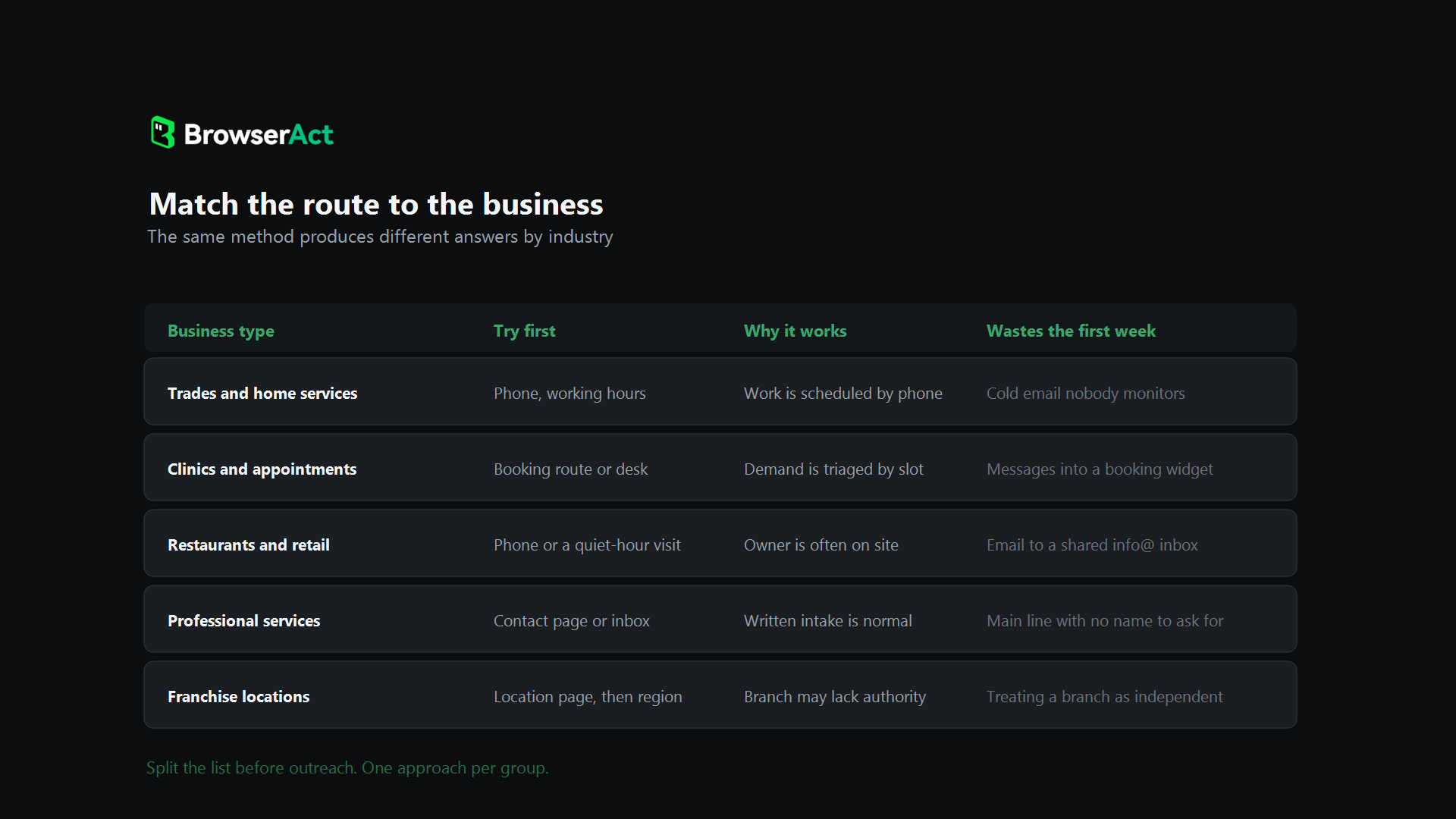
The same method produces different answers by industry, because industries handle inquiries differently. Use the second column as your first guess, then let the actual published route override it.
Business type | Route that usually works first | What that looks like in practice | Route that usually wastes the first week |
Trades and home services | Phone during working hours | Ask who schedules the work; log the name | Cold email to an inbox nobody monitors |
Clinics and appointment-based businesses | Booking route or front desk | Call during a quiet hour and ask who handles vendor decisions | Automated messages into a booking widget |
Restaurants and retail | Phone or an in-person visit | Visit before service hours and ask for the owner | Email campaigns to a shared |
Professional services and agencies | Contact page or published company inbox | Send a short written note referencing something specific | Calling a main line with no name to ask for |
Franchises and multi-location brands | Location page, then a regional contact | Check whether local authority exists before spending effort | Treating a branch listing as an independent business |
If your campaign covers several rows, split the list before outreach and prepare one approach per group. A segmented call plan beats a template applied to everyone — that is the difference between a cold calling list and a list people actually answer.
Read the Record Honestly
Every field on a Maps record was published for customers, not for your outreach. Reading it accurately is most of the skill.
Field | What you can reasonably conclude | What it does not tell you |
Phone | A public inbound channel exists | That it reaches an owner or a decision-maker |
Website | An owned destination exists and is worth checking | That the site is current, or that it has a problem you sell against |
Business hours | A published schedule exists | That it reflects this week, especially around holidays |
Category | The business describes itself in these terms | That the category is precise enough for your offer |
Reviews and rating | There is visible customer activity | Revenue, budget, or willingness to buy |
Result rank | A reproducible position in one collection run | Anything about business quality |
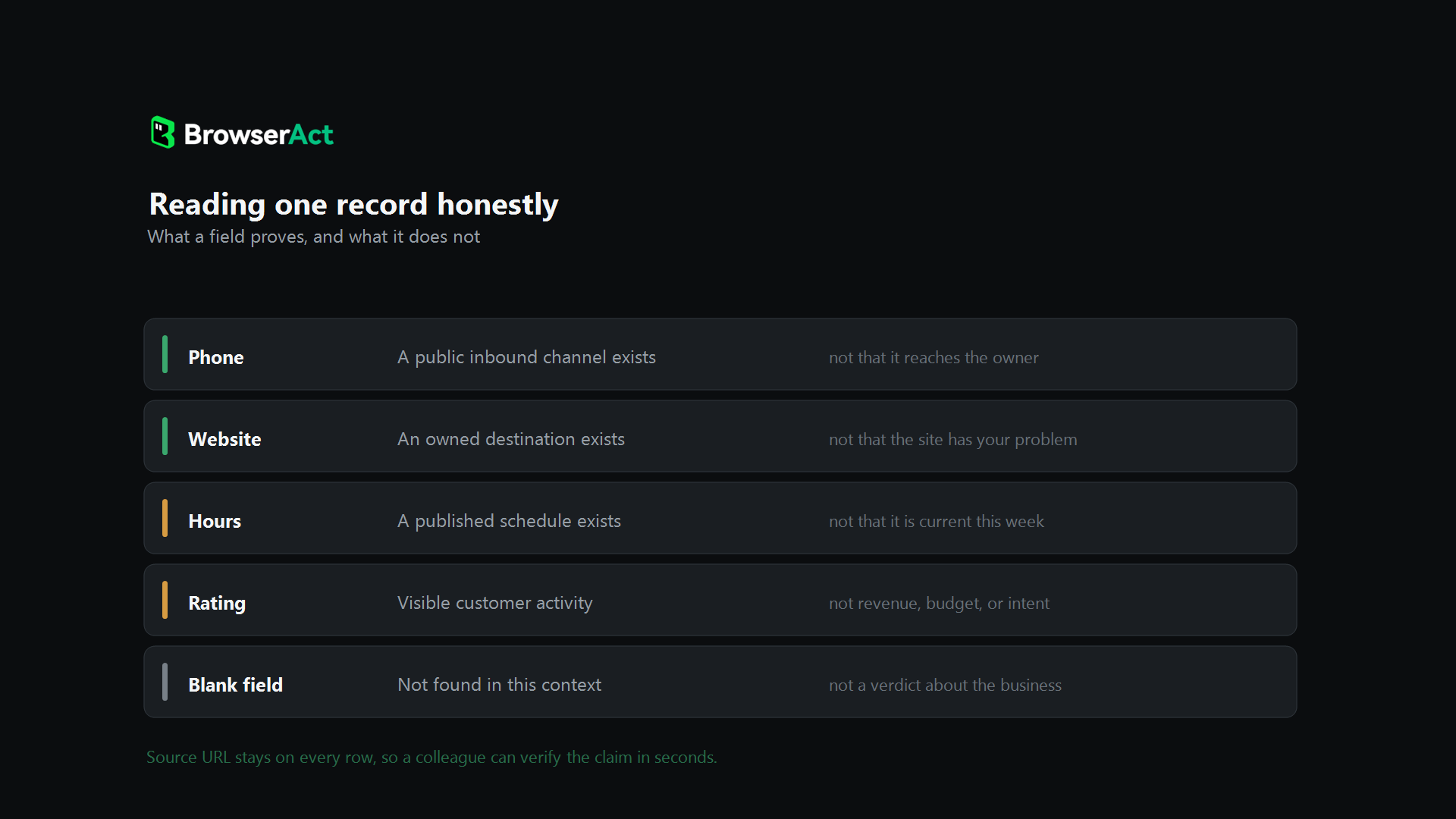
One habit covers all of them: read a value as evidence of what was published, and read a blank as "not found in this context." A blank is a research state, not a verdict about the business.
Doing This Without the Page Hopping
The walkthrough above takes twenty minutes for three rows. At three hundred rows it stops being judgment work and becomes data entry — and consistency is the first thing manual research loses.
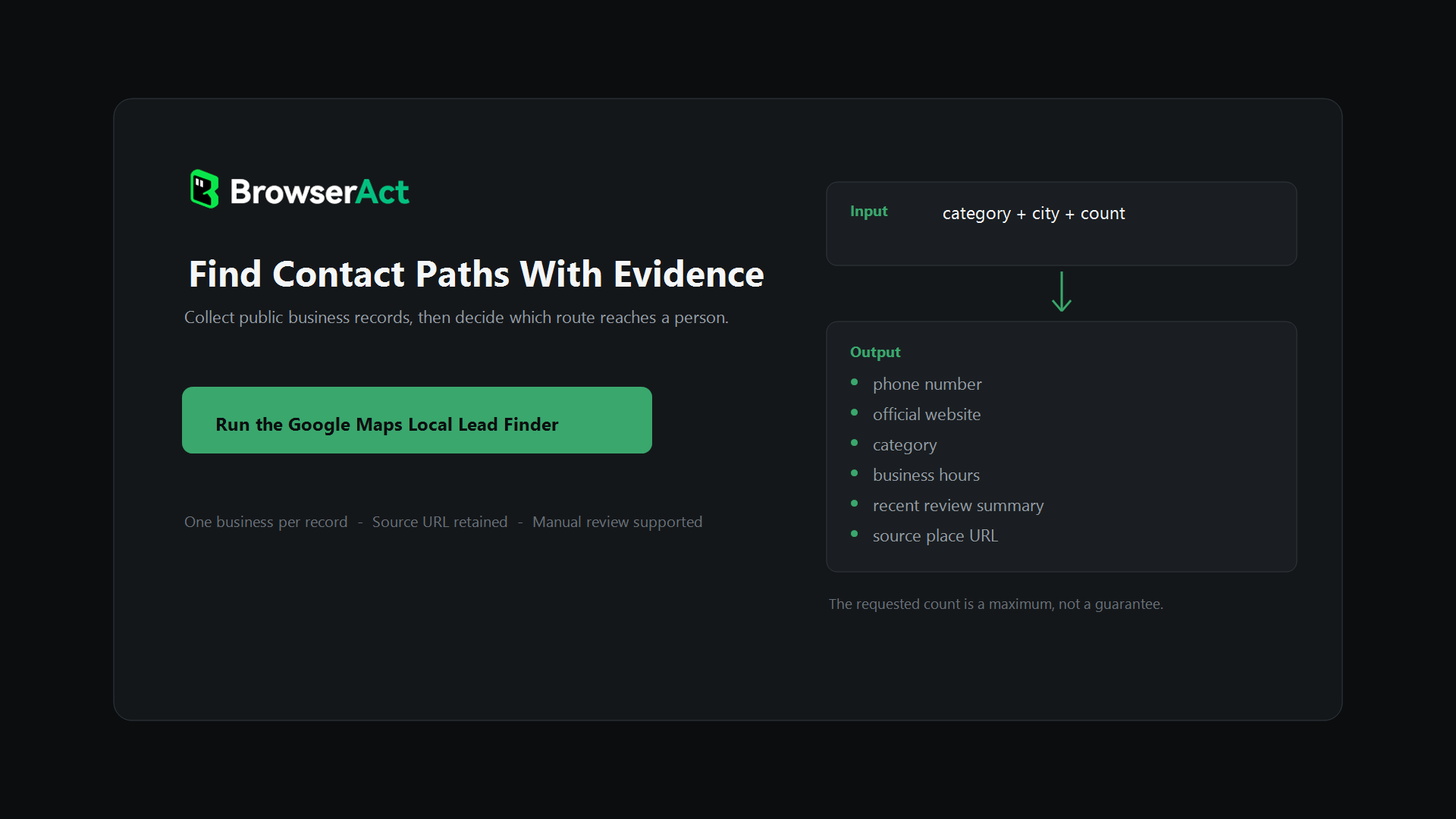
That collection step is what a reusable Bot handles. Google Maps Local Lead Finder takes a search query, a location, and a count, opens the public place detail pages for the results, and returns one structured record per business with fields such as phone, website, category, business hours, and a recent visible review summary when one is available. You describe the task in plain language, the Bot is built and tested against real public pages in the cloud, and the same Bot runs again for the next city.
Three things to know before planning a run:
- The count is a maximum, not a guarantee. What comes back depends on the query, the location, and what is publicly visible at that moment.
- It opens place details; it is not a site crawler. Detail-page collection does not audit websites.
- Email is a separate, selective step. Google Maps has no email field. When a campaign genuinely needs email, a Google Maps email scraper starts from the Maps record, follows the official website, and checks a clearly linked contact page for an address the business published itself. When nothing public is visible, that field stays empty — which is more useful than a guess, because it tells you to switch to the phone.
The right order is: collect the records, place each segment on the route table above, test the route, and only then enrich the accounts that deserve the extra step. That keeps the expensive work behind your relevance filter instead of in front of it.
Before the First Call
Run the list through a short review. It is not bureaucracy; it is what keeps a campaign from burning the domain you send from.
- The business matches the intended category and territory.
- The contact route was observed, not inferred, and its source URL is attached.
- The route was tested, and the outcome is on the row.
- Business channels are separated from anything that looks personal.
- Duplicates, branches, and parent-brand overlaps are removed.
- The outreach reason comes from a visible detail, not from a template variable.
A record that survives this is contactable. Whether it deserves your time is a separate question — how to qualify Google Maps leads before outreach covers that decision, so testing a route and judging an opportunity stay two different steps.
One limit belongs here rather than in a footnote: collecting public business information is research, not permission to contact anyone by any means. Rules differ by country, industry, and message type. This is not legal advice, and a documented public source does not replace a compliance check.
Start With One Category and One City
The tiler did not rebuild 300 rows. He rebuilt 40, in one city, in one category, and worked them properly. Twelve conversations came out of that batch — and every one of them was with somebody who could actually commission tile work.
That is the whole discipline. Local business lead generation rewards precision far more than volume, and precision starts with deciding, per row, which route reaches a person and whether it is reachable. Collect the records, match the route to the business, test it, keep the source, and move on when there is nothing public to use.
Then expand to the next city, with the same list format and the same rules.