Top 10 Best Amazon Seller Tools That Quietly Replace $300/mo in SaaS

Independent Amazon sellers do not need another dashboard.
They need answers to a few expensive questions:
- Which competitors are actually worth studying?
- Is this product getting more competitive or less?
- What are customers complaining about?
- Which keywords deserve listing work or PPC budget?
- Which tools are worth paying for, and which ones are just packaging the same public data?
That is the real test for the best Amazon seller tools in 2026. Not feature count. Not how many tabs are inside the software. Not whether the product page says "AI."
If you are doing $10K to $500K per month on Amazon, the problem is usually simpler: you are paying for Helium 10, Jungle Scout, Keepa, maybe DataDive, maybe MerchantWords, and then still exporting everything into a spreadsheet before making the actual decision.
This guide ranks the best Amazon seller tools by what they can replace in a lean seller workflow. Some tools are worth keeping. Some are useful only for a specific job. And a few browser automation skills can quietly replace large chunks of a traditional $300/month Amazon FBA software stack.
The goal is not to cancel every subscription. The goal is to stop paying recurring SaaS fees for data you only need in small, repeatable pulls.
1. Amazon Competitor Analyzer by ClawHub
Amazon Competitor Analyzer is the first tool I would test if your current workflow starts with opening Amazon search results, clicking the top listings, and manually copying price, reviews, rating, and rank signals into a sheet.
That is still how a surprising number of operators do early niche validation.
This ClawHub skill replaces the most repetitive parts of Helium 10 X-Ray and the Jungle Scout extension: pulling the top visible competitors for a keyword and turning the search results into structured data you can actually compare.
Use it when you need to:
- Pull the top 10 ASINs for a target keyword
- Compare price, rating, review count, and visible product metadata
- Build a quick competitor snapshot before launching a new offer
- Refresh the same keyword every week without opening five dashboards
Example workflow:
browser-act stealth-extract \
  "https://www.amazon.com/s?k=your+niche+keyword" \
  --fields "title,asin,price,rating,reviews,bsr" \
  --output top10.json
The user benefit is speed. You are not trying to replace every forecasting model in a full suite. You are replacing the "copy data from Amazon into a spreadsheet" step, which is where small sellers waste a lot of time.
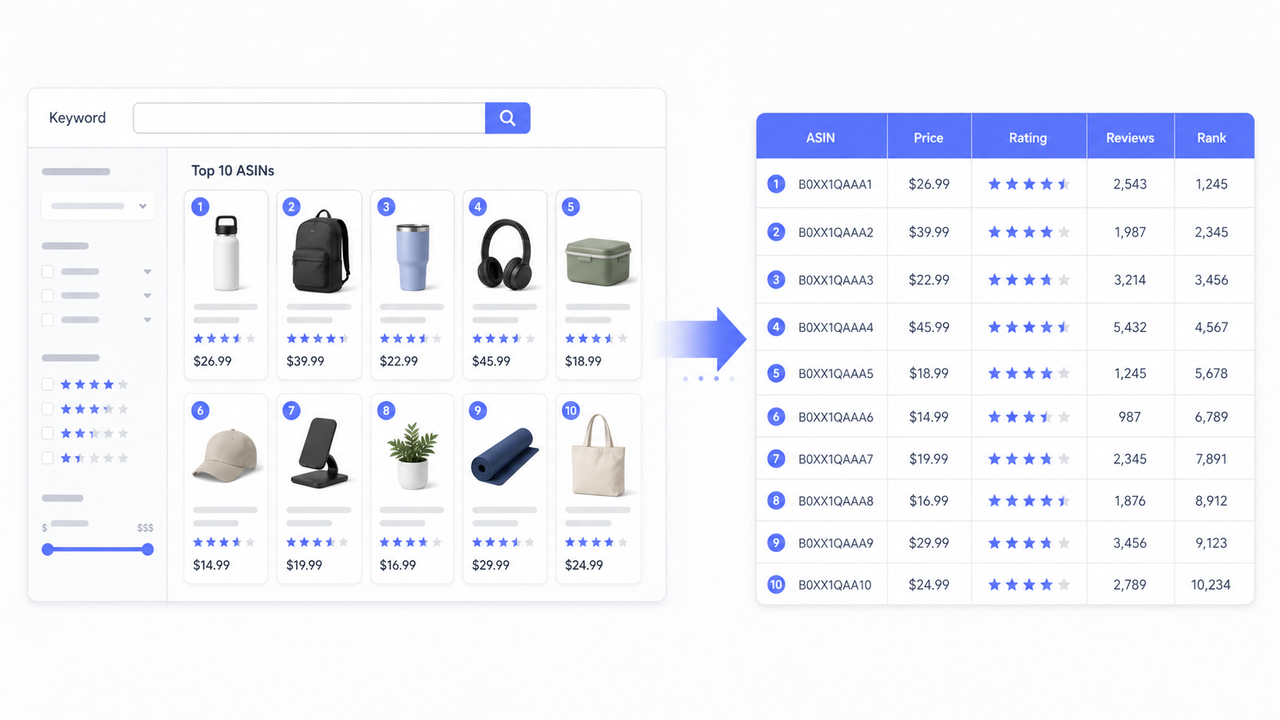
Best fit: sellers who already know their category and need fast competitor analysis.
Not ideal for: sellers who want a beginner-friendly product discovery interface with built-in opportunity scoring.
2. Amazon Product API Skill by ClawHub
Amazon Product API Skill is useful because most sellers do not actually need the full Amazon Product Advertising API or Selling Partner API for basic product research.
They need product data for a list of ASINs.
Official Amazon APIs are powerful, but the setup can be slow, approval-dependent, and overbuilt for simple research jobs. This skill gives you a lighter path: drop in an ASIN and get structured product data back.
Example:
browser-act stealth-extract \
  "https://www.amazon.com/dp/B08N5WRWNW" \
  --fields "title,price,bullets,images,variations"
This is especially useful inside an agent workflow. You can have Claude, ChatGPT, Codex, or an internal script collect product details, compare bullet structures, summarize image positioning, and flag missing offer information.
Best fit: sellers who want a practical Amazon product data API workflow without spending days on API setup.
Not ideal for: inventory, order management, checkout, or seller-account operations. Use Amazon's official SP-API for those.
3. Keepa
Keepa is the one paid tool I would not try to recreate.
Current Amazon data is easy to collect. Historical price and sales-rank data is not. Keepa has years of price history, rank movement, Buy Box changes, coupon visibility, and marketplace-level tracking that a normal seller cannot rebuild by scraping Amazon today.
Use Keepa for:
- Price history
- Sales-rank history
- Buy Box behavior
- Long-term seasonality checks
- Spotting temporary spikes before you trust a product idea
The best use of Keepa is not browsing charts for fun. It is using history to avoid bad assumptions.
If a product looks great today but only because the top competitor went out of stock last week, Keepa can show you. If a niche has a holiday spike that disappears for nine months, Keepa can show you. If the price has been collapsing for two years, Keepa can show you.
Best fit: every serious seller doing product validation or competitive monitoring.
Not ideal for: replacing current-page data extraction. Pair it with ClawHub skills instead.
4. Helium 10
Helium 10 is still valuable, but most independent sellers do not need the full suite every month.
The strongest reason to keep Helium 10 is keyword research. Cerebro and Magnet are hard to replace cleanly because reverse-ASIN keyword discovery depends on data that is not visible on a normal Amazon product page.
Use Helium 10 when you need:
- Reverse-ASIN keyword research
- Keyword expansion
- Listing keyword gap analysis
- Launch planning for a product you have not yet validated
Where sellers overspend is using Helium 10 for jobs that can be handled by cheaper tools: current competitor snapshots, basic ASIN lookups, review pulls, or simple price checks.
The lean approach is to keep Helium 10 only when keyword research is the current bottleneck, then downgrade or pause when you are not actively doing that work.
Best fit: keyword research and launch-stage planning.
Not ideal for: routine current data pulls that can be scripted.
5. Amazon ASIN Lookup Skill by ClawHub
Amazon ASIN Lookup Skill is for one of the least glamorous but most common seller jobs: taking a messy list of products and turning it into usable ASIN-level data.
If you work with supplier catalogs, wholesale sheets, replenishment lists, or SKU exports, you already know the pain. The SKU in your internal system is not always the ASIN you need for Amazon research.
This skill helps convert SKU or ASIN inputs into structured product records.
Example:
browser-act stealth-extract \
  "https://www.amazon.com/dp/{asin}" \
  --batch asins.csv
Use it when you need to:
- Enrich a CSV of ASINs
- Check whether products still exist
- Pull current title, price, rating, and offer details
- Build a lightweight ASIN lookup tool without another subscription
Best fit: operators who work in spreadsheets and need repeatable product enrichment.
Not ideal for: official catalog changes or seller account operations.
6. Jungle Scout
Jungle Scout is still one of the better beginner-friendly Amazon seller tools for product discovery.
Its value is not that it can show you data Amazon hides from everyone else. Its value is that it packages the discovery process in a way newer sellers can understand: filters, estimates, opportunity scoring, and niche-level exploration.
Use Jungle Scout when you need:
- Product discovery workflows
- Beginner-friendly niche research
- Opportunity scoring
- A guided interface instead of scripts and spreadsheets
Experienced operators often outgrow it because they develop their own filters. Once you know what signals matter in your category, a lot of discovery becomes repeatable. At that point, paying every month for the same interface may stop making sense.
Best fit: first-time or early-stage sellers choosing a market.
Not ideal for: experienced sellers who already have a category and need lean monitoring.
Stop getting blocked. Start getting data.
- ✓ Stealth browser fingerprints — bypass Cloudflare, DataDome, PerimeterX
- ✓ Automatic CAPTCHA solving — reCAPTCHA, hCaptcha, Turnstile
- ✓ Residential proxies from 195+ countries
- ✓ 5,000+ pre-built Skills on ClawHub
7. DataDive
DataDive is more specialized than broad tools like Helium 10 or Jungle Scout. It is strongest when listing optimization and keyword decisions are already your bottleneck.
Use DataDive when you need:
- Listing optimization
- Keyword relevance analysis
- Title and copy improvement
- Structured launch research
The mistake is buying DataDive too early. If your product is not validated, your offer is weak, or your PPC structure is messy, listing optimization software will not save the business.
Buy it when you have traffic, competitors worth studying, and enough sales data to make optimization worthwhile.
Best fit: sellers improving listings in a proven niche.
Not ideal for: basic product research or early competitor scraping.
8. Amazon Reviews API Skill by ClawHub
Amazon Reviews API Skill replaces one of the most underrated research workflows: reading what customers actually say.
Review data is where you find product gaps, packaging complaints, missing accessories, confusing instructions, and quality issues competitors have normalized.
Example:
browser-act stealth-extract \
  "https://www.amazon.com/product-reviews/B08N5WRWNW?sortBy=recent" \
  --fields "rating,title,body,verified,date"
Once you have review text in JSON or CSV, the real work becomes analysis:
- Group complaints by theme
- Separate verified-purchase reviews from weaker signals
- Find phrases customers use repeatedly
- Compare positive and negative language across competing ASINs
- Feed the data into Claude or another LLM for sentiment clustering
This can replace a surprising amount of expensive "AI review analysis" software because the valuable part is not the dashboard. It is having the raw customer language in a clean format.
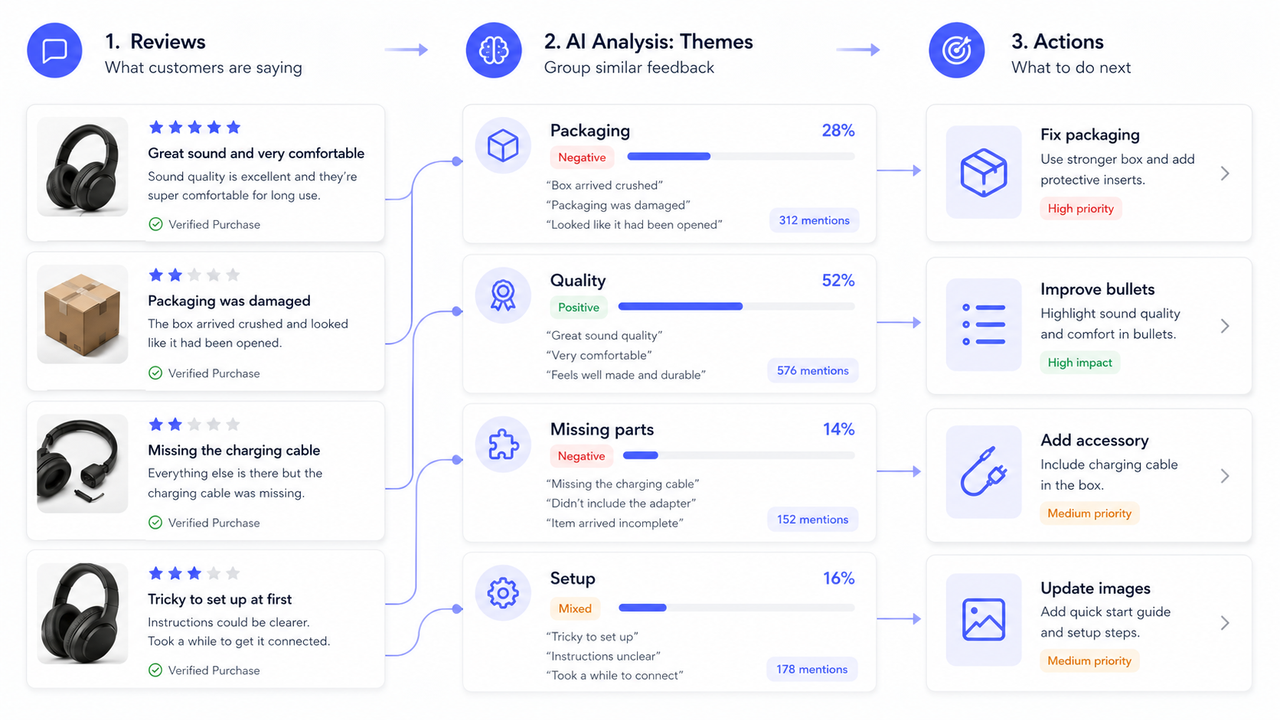
Best fit: product improvement, listing copy, customer research, and competitor teardown.
Not ideal for: fake-review enforcement or official Amazon compliance decisions.
9. SellerSprite
SellerSprite is widely used by China-based Amazon teams and suppliers. If your sourcing, operations, or partner team is in Shenzhen, there is a good chance someone already uses it.
SellerSprite can be useful for:
- Product research
- Keyword research
- Competitor tracking
- Market research workflows for Chinese seller teams
The key question is not whether SellerSprite is "better" than Helium 10. It is whether your team already works in its ecosystem. If your suppliers, VAs, or China-side team use SellerSprite, standardizing around it may save more time than forcing everyone into another tool.
Best fit: sellers working closely with China-side teams.
Not ideal for: operators who want a minimal, scriptable stack.
10. MerchantWords
MerchantWords has a narrower job: Amazon keyword and search-volume research.
That can still matter. Google Keyword Planner does not tell you how people search inside Amazon. Amazon shoppers search closer to purchase, and those phrases often look different from broad Google keywords.
Use MerchantWords when you need:
- Amazon-specific keyword ideas
- Search-volume estimates
- Marketplace-level keyword expansion
- PPC and listing keyword inputs
It is less useful if you already have keyword coverage from Helium 10, DataDive, or internal ad data. Do not pay for overlapping keyword tools unless you have a clear reason.
Best fit: sellers who need one focused keyword-volume source.
Not ideal for: competitor data extraction, review analysis, or product-page enrichment.
The Lean Amazon Seller Stack
Here is the practical version.
You probably do not need Helium 10, Jungle Scout, Keepa, DataDive, MerchantWords, plus a separate AI dashboard. That stack can easily pass $300 per month before you have made a single better product decision.
A leaner stack looks like this:
- Keepa for price and rank history
- Helium 10 only when reverse-ASIN keyword research is active
- ClawHub skills for current product, competitor, ASIN, and review data
- A spreadsheet or agent workflow to connect the outputs
That gives you the data you need without paying five vendors to repackage overlapping signals.
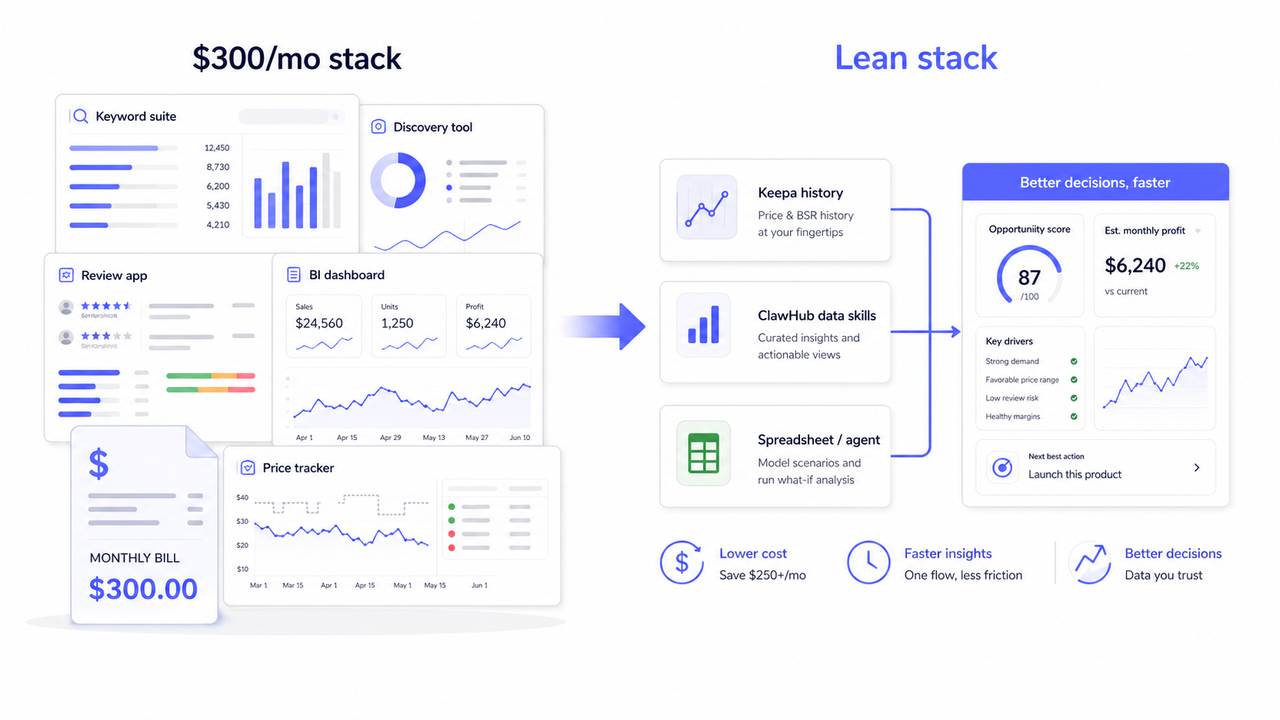
The rule is simple: pay for databases you cannot rebuild, and automate current data you can pull on demand.
What This Replaces
ClawHub skills are not a full Amazon seller suite, and that is the point.
They are best used to replace narrow, repeated jobs:
- Current competitor snapshots
- ASIN enrichment
- Product-page data pulls
- Review extraction
- Repeatable Amazon scraping tools for research workflows
- Lightweight Amazon competitor analysis
They should not replace:
- Official inventory or order workflows
- Seller Central account actions
- Compliance-sensitive automation
- Historical databases like Keepa
- Deep keyword databases like Cerebro or MerchantWords
If you hit Amazon's bot detection blocking your scraper, the fix is in the stack choice, not in another paid solver.
This distinction matters because it makes the recommendation more credible. The best Amazon seller tools are not the tools that claim to do everything. They are the tools you trust for the one job they are actually built to do.
Final Thought
The sellers who win in 2026 are not always the ones with the longest SaaS stack.
They are the ones who know which data is worth paying for, which data can be pulled on demand, and which decisions deserve human judgment.
Keep the paid tools that give you proprietary history or hard-to-rebuild keyword data. Replace the current-page research chores with agent-native skills. Then put the savings into better inventory, better creatives, or PPC tests.
Most sellers will keep paying for convenience.
The operators who build a leaner stack will move faster, spend less, and understand their own data better.
Browse the full ClawHub Amazon skill set: https://clawhub.ai/
Automate Any Website with BrowserAct Skills
Pre-built automation patterns for the sites your agent needs most. Install in one click.
Further reading: Amazon product research
Frequently Asked Questions
What are the best Amazon seller tools for independent sellers?
The best Amazon seller tools for independent sellers are usually a lean mix: Keepa for price history, Helium 10 for reverse-ASIN keyword research when needed, and ClawHub skills for current product, competitor, ASIN, and review data extraction.
Can ClawHub skills replace Helium 10?
They can replace some Helium 10 workflows, especially current competitor research and product-page data pulls. They do not fully replace Cerebro or Magnet for reverse-ASIN keyword research.
Do I still need Keepa?
Yes, if you care about price history, rank history, Buy Box behavior, or seasonality. Keepa's historical database is difficult to recreate with current Amazon scraping tools.
Are Amazon scraping tools safe to use?
Use scraping tools for research data, not for account actions, checkout flows, or anything compliance-sensitive. For seller-account operations, inventory, and orders, use Amazon's official SP-API. See our captcha primer for anti-bot context.
How much can this stack save?
If you currently pay for multiple overlapping tools, a lean stack can reduce recurring software costs by $100 to $250 per month. The exact savings depend on which subscriptions you pause, downgrade, or replace.
What is the best Amazon product data API option?
For official seller operations, use Amazon's official APIs. For lightweight research workflows, a tool like ClawHub's Amazon Product API Skill can be faster to set up and easier to use inside an agent workflow.


