eBay Price Tracker: Compare Black Friday Prices, Shipping, and Condition

A competing eBay listing drops below your Black Friday price. Before matching it, check the item's condition, included accessories, and shipping charge. A used unit with paid shipping may be a poor comparison for your new, complete product. An eBay price tracker is useful when it preserves those differences instead of returning a price alone.
Build a small set of comparable listings, record their current offers, and repeat the checks. BrowserAct's eBay Product Details Scraper collects public item information, including price, condition, seller, and shipping details when displayed. Use the records to review a change before deciding whether your own offer needs attention.
- 1Match the item's condition and included contents before comparing prices.
- 2Include known shipping costs, and keep missing charges marked as unknown.
- 3Separate current asking prices from evidence of what buyers actually paid.
- 4Review missing fields and ended listings before acting on a change.
Match the Item Before You Compare Its Price
A shared keyword is a starting point for finding listings, not proof that they belong in the same comparison. Two titles can describe the same model while offering different quantities, conditions, or contents.
Check Model, Identifiers, Condition, and Included Parts
Confirm the model and any visible identifiers, such as an MPN, UPC, or EAN. Then check the condition, pack size, included parts, and relevant specifications. For a camera, a body-only listing should be separated from a kit with a lens. For electronics, “for parts” belongs outside a working-product price comparison.
The eBay Product Listings Bot can help discover candidates. Review those candidates before turning them into a monitoring list. Use three categories: comparable, excluded, and needs a manual check. An absent identifier belongs in the third category if the remaining information cannot establish a match.
Keep Auctions Separate from Fixed-Price Listings
An auction's current bid is not equivalent to a fixed asking price. It can change before the auction ends, and any reserve or buying conditions may affect what the displayed number means.
Check the listing type on the source page or in your discovery records. Keep auctions in a separate group if you monitor them at all. The Product Details template does not bid or buy; its job is to record public information. Do not infer a final auction result from a mid-auction check.
Compare the Item Price and Known Shipping Cost
Compare the item price together with shipping that is actually shown for the observed context. Keep the currency and shipping text with the numeric fields. If the delivery destination or shipping method differs, flag the comparison for review.
Adding item price and known shipping gives a useful subtotal. It is not necessarily the final checkout amount: taxes, import charges, discounts, or delivery conditions may still apply. A missing shipping value is unknown, not zero.
The following teaching example uses hypothetical listings and prices. It is not a current eBay offer or a Bot run.
Illustrative input: three fixed-price listings for the same model, with condition and contents checked on their source pages.
Listing | Condition and contents | Item price | Known shipping | Review decision |
A | New, complete | $30 | $6 | $36 item-plus-shipping subtotal |
B | New, complete | $32 | $0 | $32 subtotal; comparable with A if other conditions match |
C | Used, missing an accessory | $24 | Unknown | Separate group; no comparable subtotal |
Listing B has a higher item price than A but a lower known subtotal. Listing C cannot establish a lower comparable price: both its condition and its shipping information differ.
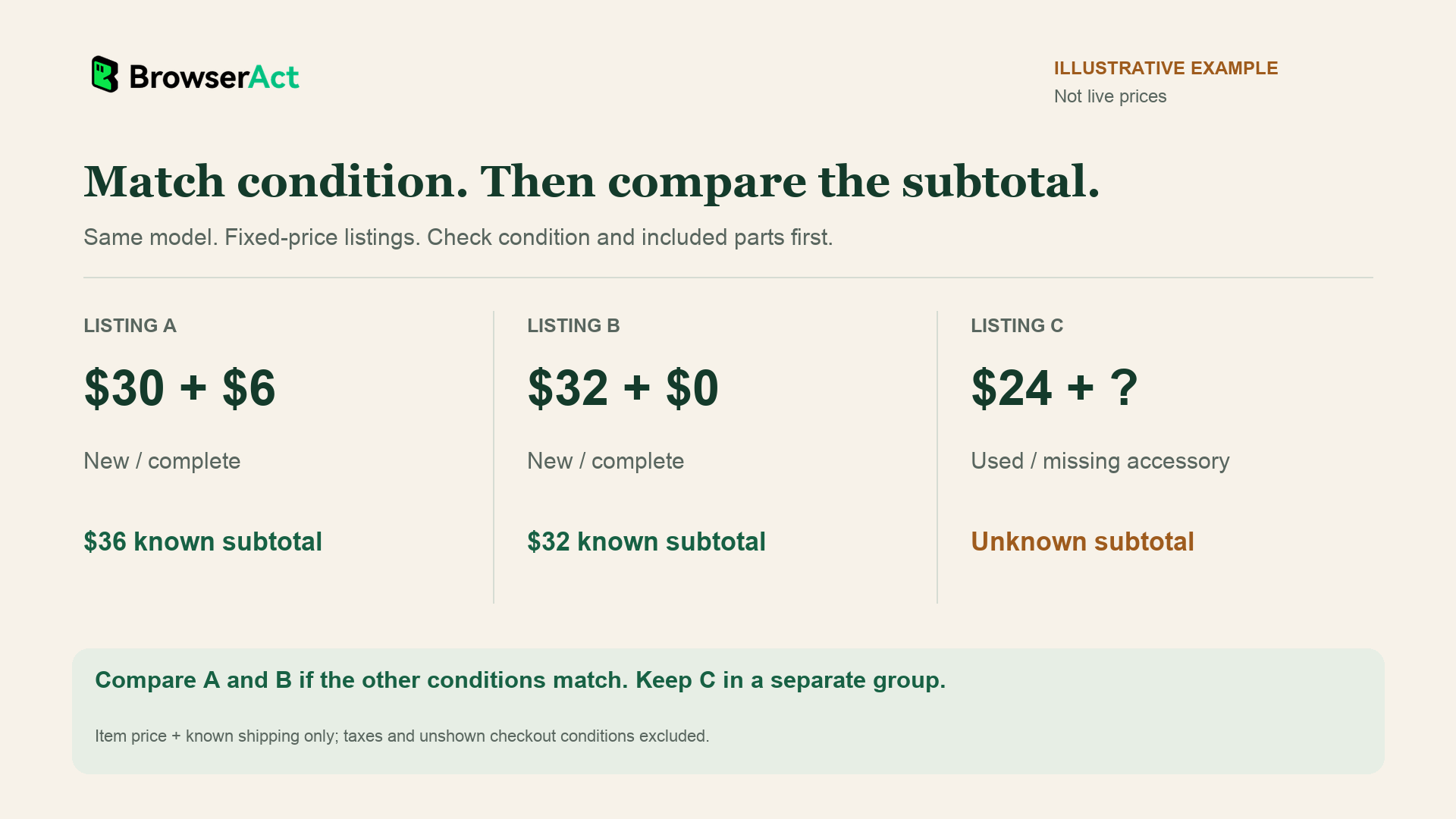
Illustrative comparison, not live prices. Match condition and contents, then add known shipping; keep incomplete offers separate.
That is the kind of decision a review table should make easier. It should not silently flatten all three listings into one “lowest market price.”
Capture Current Listings with the eBay Product Details Bot
Once you have matched the listings, collect a baseline for the URLs you want to follow. Keep the original source links so you can investigate a questionable result later.
Supply Product URLs and Count
Open the eBay Product Details template. Enter one or more public item links in Product URLs, and set Count to the maximum number of supplied URLs to process. Count limits the supplied list; it is not a request to discover that many new competitors.
Run the template and inspect the returned item number, title, and source or canonical URL. Confirm that each result still corresponds to the intended listing. Redirected or ended pages need attention before their output enters a price comparison.
Keep the Source URL, Seller, and Observation Time
Save the result with a separate check time and time zone. A compact review record can use these fields:
Information | Why keep it |
Source URL, canonical URL, and item number | Identify the listing and investigate redirects |
Current price and currency | Keep the amount tied to its currency |
Condition and item specifics | Preserve the basis for a product match |
Shipping cost and shipping text | Retain numeric charges and any qualifications |
Seller and item location | Spot a change in the offer's context |
Availability text and error | Separate valid observations from unavailable or problematic inputs |
Optional fields can be empty when the page does not display them. Keep the original output as well as your shorter comparison table. Your spreadsheet may add a check time and classification, but those notes should remain distinguishable from the values collected from the listing.
Repeat Checks and Handle Ended or Unavailable Listings
Repeat the check against the same item URLs. BrowserAct supports schedules for published Bots at hourly, daily, or weekly intervals, with a selected time zone and notification settings. To continue monitoring, configure a published Bot for the task and choose an interval your team can review. A single template run does not create an ongoing schedule by itself.
During preparation, you might review a small list daily. During a short promotion, you may choose a shorter interval if the decisions justify it. Scheduled observations do not capture every price between runs, so avoid describing them as a continuous live feed.
When a listing ends, keep its previous records and mark its current state. Do not replace its missing price with zero. If a URL redirects to another product or a search page, it should not become a valid new price for the original item. Inspect the error or partial result and check the source.
Treat a replacement listing as a new entry, even if the seller or title looks familiar. Match its identifiers, condition, contents, and shipping again. This keeps your record from suggesting a price movement between two different offers.
Keep Asking Prices Separate from Sold-Price Evidence
An active listing tells you what a seller is asking under the displayed conditions. It does not tell you what buyers ultimately paid.
The Product Details Bot may return a visible sold_count, but that field is not a transaction history. It does not supply each sale's price or prove that the current asking price applied to previous sales. A change in the count also does not reveal accepted offers, refunds, or the economics of an individual transaction.
If your decision needs completed-sale evidence, research that separately using the relevant eBay tools available to your account. Keep those findings in a different column or dataset from active asking prices. Current competition and past transactions answer related questions, but they should not be presented as interchangeable measurements.
Use Comparable Changes to Review Your Black Friday Offer
Start with changes that could affect your own offer: a matched fixed-price listing lowers its price, changes its shipping terms, or becomes unavailable. Then confirm that the comparison conditions still hold.
Before responding, calculate your own costs and fees, check stock, and review delivery commitments. A competitor's low asking price does not reveal their margin or establish the price you can afford. You may decide to keep your price because your item includes more, ships differently, or serves a different buyer.
Give the review a named owner and a rule for handling unknowns. For example, pause a price response when shipping is missing, and reopen the listing before acting. An eBay price tracker becomes more useful when it leads to a specific decision rather than an unreviewed list of alerts. The template collects information; changes to your own listings remain separate actions.
FAQ
Can I compare new and used listings for the same model?
Keep them in separate groups. The model may match, but condition, included parts, warranty terms, and buyer expectations can differ. A new-versus-used comparison can inform a broader market review, but it should not be treated as a direct price reduction on an equivalent offer.
How should auction listings be handled?
Separate them from fixed-price listings and record the observation context. A current bid is provisional, not a completed sale price. This template reads public item information and does not bid, buy, or establish the eventual auction outcome.
What if the shipping cost changes or is missing?
Check the source page and the delivery conditions. A shipping change can alter the comparison even if the item price stays the same. When the charge is unavailable, keep it unknown and avoid calculating a complete item-plus-shipping subtotal.
Does sold_count tell me the price buyers actually paid?
No. It is a visible quantity-related field, not a record of individual transaction amounts. Do not multiply it by the current asking price to estimate actual revenue. Research completed-sale prices separately when the decision requires them.
What happens when a monitored listing ends?
You may receive partial information or an error for an unavailable input. Keep the earlier observations, check the source, and mark the listing's state. Do not treat a replacement page as the same product without matching it again.
Build a comparable eBay listing record. Start with a few checked item URLs, keep condition and shipping beside the price, and save a baseline you can review again.