
Craigslist Listings Scraper
Automatically extract ordered public Craigslist listings for one market and category with our no-code scraper. Capture structured listing records for classified listing monitoring, local market.
Published by
Br
BrowserAct Team
September 15, 2026
Approx.Credits
22-34 Credits
Categories
BA
APICraigslist
Template ID
118369142108598498

Brief
Brief
Automatically extract ordered public Craigslist listings for one market and category with our no-code scraper. Capture structured listing records for classified listing monitoring, local market research, and downstream automation. Configure the request, run the Bot, and receive one predictable structured response without rebuilding the workflow.
What Does BrowserAct Craigslist Listings Scraper Do?
The Bot extracts ordered public Craigslist listings for one market and category. It stays within the selected public page flow and returns structured listing records ready for review or automation.
Key Features
- Reads public Craigslist data without requiring an account login.
- Uses non-empty defaults so the template can run immediately.
- Maps finite website options to dropdown inputs when available.
- Returns structured values from the selected capability only.
- Keeps conditional values empty only when the public page does not display them.
Quick Start
1. Open Run Task.
2. Review or change the populated input values.
3. Run the Bot.
4. Review the structured result in the Output Tab.
5. Connect the published template to your downstream workflow when needed.
Input Parameters
| Parameter | Configuration |
|---|---|
market | Dropdown; required; default New York. Choose one supported market option. Options: New York, Los Angeles, Chicago, Boston, San Francisco Bay Area, Seattle, Austin, Miami. |
category | Dropdown; required; default For Sale. Choose one supported category option. Options: For Sale, Housing, Jobs, Gigs, Services, Community. |
sort | Dropdown; required; default Newest. Choose one supported sort option. Options: Newest, Relevant. |
keyword | String; required; default bicycle. Search text entered by the user. |
start_position | Integer; required; default 1. First one-based source position eligible for output. |
exclude_listing_urls | String; required; default none. Previously collected identifiers or URLs to skip; use none when not needed. |
max_results | Integer; required; default 10. Maximum number of records to return. |
Example Output
The table shows one representative real result. Long text is shortened only in this documentation preview.
| Field | Result |
|---|---|
position | 1 |
title | Vintage full suspension 16.5 |
price | $505 |
posted_date | <1hr ago |
location | Queens |
bedrooms | null |
image_url | https://images.craigslist.org/d/7962589968/00P0P_1OoQ1haUglW_0t20CI_600x450.jpg |
listing_url | https://www.craigslist.org/view/d/kew-gardens-vintage-full-suspension-165/5GyWAsdoGZfrURVWcPF9cV |
source_page_url | https://www.craigslist.org/search/area/newyork?cat=sss&query=bicycle&sort=date |
next_start_position | 2 |
How Does It Work?
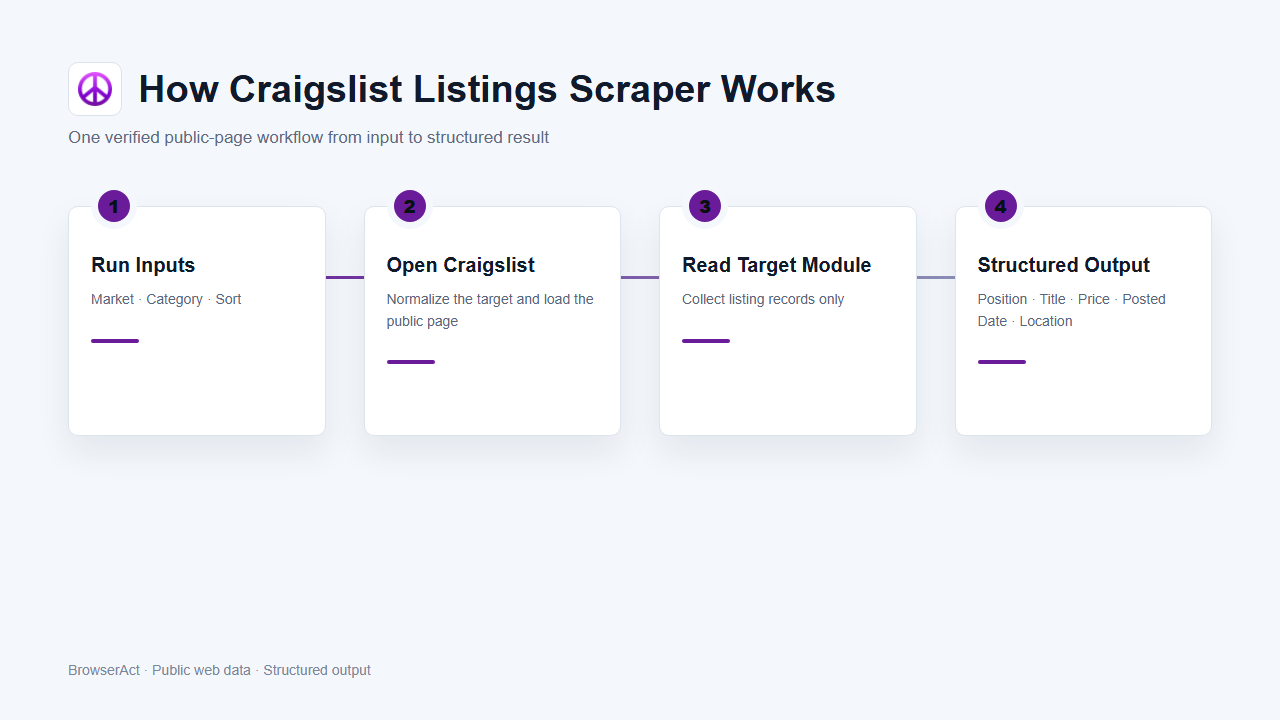
1. BrowserAct validates the supplied inputs and maps supported dropdown selections.
2. The Bot constructs or normalizes the target URL and opens the selected public listing or search page.
3. It reads eligible listing records in source order without entering unrelated pages or account-only areas.
4. It normalizes visible values, preserves valid optional values, and stops when the requested result limit or the end of the public list is reached.
5. The run returns one structured response for review, export, or downstream automation.
Use Cases
- Classified listing monitoring.
- Local market research.
- Inventory discovery.
- Connect the structured result to API clients, n8n, Make, Zapier, MCP-based agents, or supported exports.
Create Your Own Craigslist Listings Scraper
Step 1: Create an Editable Copy
Click Create Editable Duplicate in the upper-right corner of this page. An editable copy will be added to your BrowserAct workspace.
Step 2: Customize the Bot When Needed
Open the duplicate from your Bots list. Use Improve only when you need to change inputs, extraction behavior, or output fields. If the current workflow already fits, use it as is and find its Bot ID in the Bots list.
Step 3: Run the Bot Through the API
Use the Bot ID with the BrowserAct API to invoke your workflow programmatically and retrieve structured results in your application.
Automation and Export
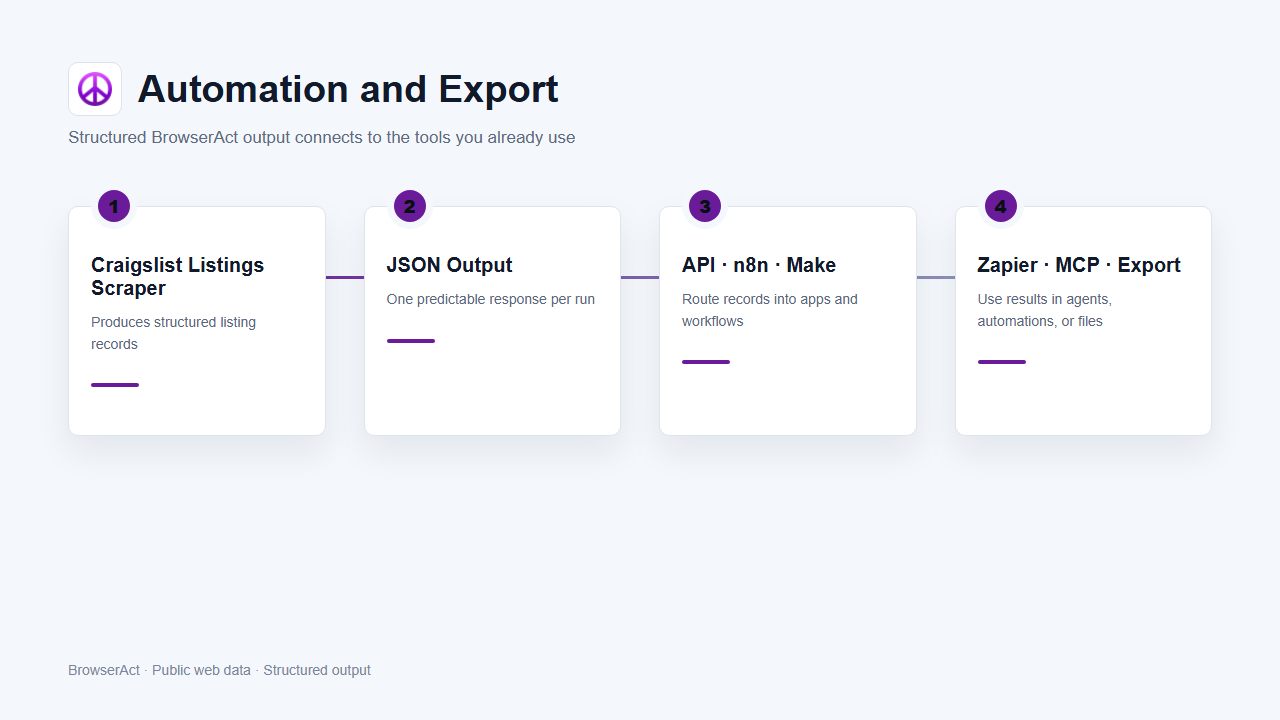
BrowserAct produces structured data first. Use the result through Run Task, the JSON API, n8n, Make, Zapier, MCP-based agents, or the supported manual export flow.
Need Help?
Cannot find the exact capability you need, or need help composing several Bots?
 What can we do for you